Click any timestamp to jump to that moment in the video.
Why Wooster Only Makes Paint Applicators
0:01 A.J. Ernst: We only do paint applicators. We're not involved in paint. We're not involved in anything else. We spend our entire days thinking just about the pain points for painters, how to improve their experience. The other thing is paints are always changing. And so we spend a lot of time testing paints, testing how our products perform, with the goal of the experience is positive. The DIYers continue to return to the category, and the professional painter continues to buy our products.
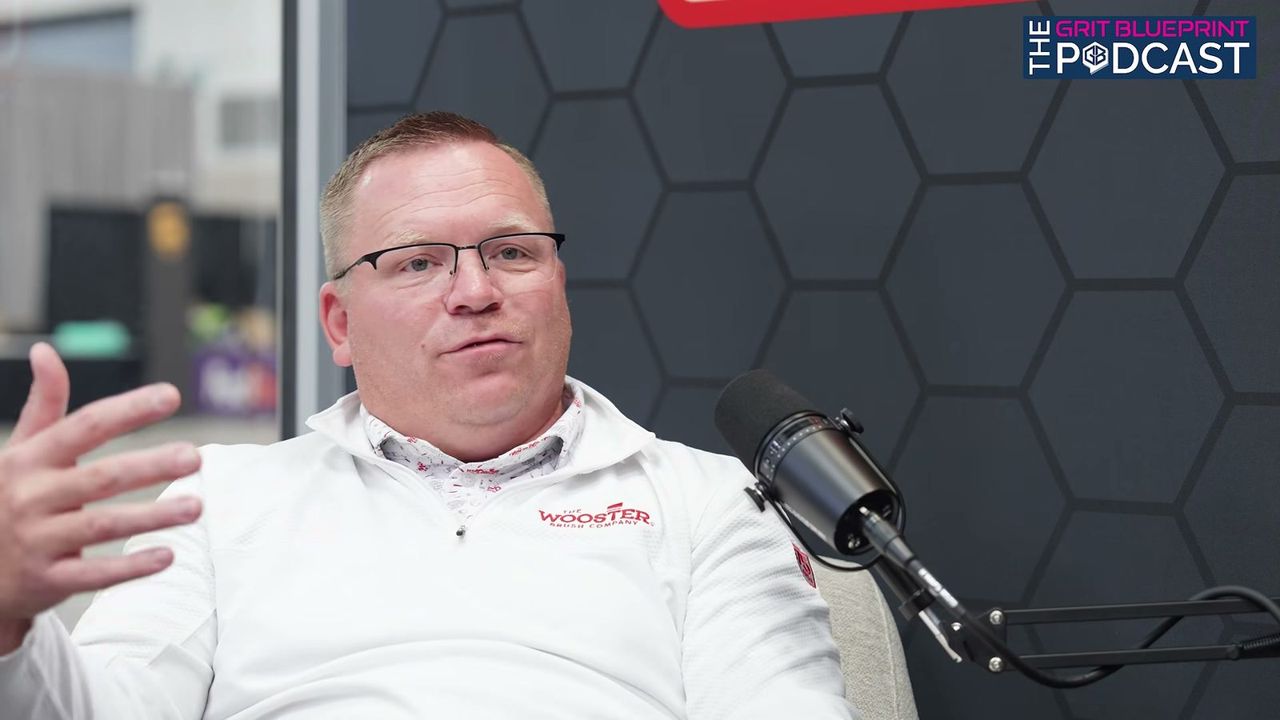
0:34 Stefanie Couch: Welcome to the Grit Blueprint Podcast. I am your host, Stefanie Couch, and today we are coming to you live from the floor at the Do it Best group market in Indianapolis. I am joined by my guest. This is an exciting one for me because I have a long history with this company. This is A.J., and he is from a company called Wooster Brush. Welcome to the show, A.J.
0:54 A.J. Ernst: Thank you for having me.
0:55 Stefanie Couch: Tell me a little bit about you and your background and how long you've been working with this company.
0:58 A.J. Ernst: A.J. Ernst. I'm the director of sales. I've been with Wooster Brush since January of 2018.
1:05 Stefanie Couch: Okay.
1:05 A.J. Ernst: And so that's nine. Nine years, I believe, where I'll be starting my ninth year here. I've held three or four different positions there. Currently director of sales. So anything painting, hardware reports to me, and I also have my hands in customer service.
1:22 Stefanie Couch: Okay.
1:22 A.J. Ernst: As well as sales support.
Wooster Brush Turns 175: What Was Happening in 1851
1:24 Stefanie Couch: Lots of different things. You're doing well. I love this company, and I did not realize this until we started talking about doing this podcast. You guys are actually celebrating 175 years this year. And that is pretty insane. I don't know, a lot of companies, they hit 100. You hear about that sometimes. But 175 years is a long time. And this company is one that I love because I used to sell this product line in my dad's lumberyard and hardware store. And my granddad was actually a painter, and he loved this line, and he actually would only paint with this brush. So this was his choice. And I love that. I wanna think about what was happening 175 years ago, because that's really what I was thinking when I heard that. It's a long time. So 1851 is when Wooster Brush was started. Millard Fillmore was president. I mean, I don't know if you know old Millard. I personally don't. The book Moby-Dick had just come out, and they had just patented the Singer sewing machine. So, I mean, that was a big deal. And you see those super old sewing machines, those came out the same year as you guys started your brush company. And it was actually seven more years after that before they had a telegraph going across the Atlantic. So you guys have been around a long time, but you're also a very innovative company, and you're doing a lot to actually change the way that paint applicators are made and thought about in the world. So tell me a little bit about how you're doing that at Wooster.
2:52 A.J. Ernst: The one thing I always talk about with customers is we only do paint applicators. We're not involved in paint. We're not involved in anything else. And so we spend our entire days thinking just about paint, the pain points for painters, and how to improve their experience. The other thing is, paints are always changing. And so we spend a lot of time testing paints, testing how our products perform, with the goal of the experience is positive. The DIYers continue to return to the category, and the professional painter continues to buy our product.
3:31 Stefanie Couch: Yeah, and I think that when you think about a DIYer, you know, I actually was thinking about this a lot when we just did our Grit Studios project. We were remodeling a lot. When we walked in, it had this yellow and gold stripe at the top. It was a gym for a little while, and so it was pretty atrocious, unless you're a Michigan fan, which I'm not. So we had to paint over that. And we're standing in the paint applicator aisle, and I was looking at all these options, thinking, hey, what is the right choice? What is the thing that I'm going to choose? I've always loved this little guy, this Shortcut. It's one of my favorites to grab because it's really easy to use, and you can kind of get it anywhere. But on a bigger project, you're not sure what to do. So how do you guys actually help DIYers, and even the dealers and paint distributors that are selling these products, to be able to know what to choose and how to use the best thing for their job?
3 Questions That Help Customers Pick the Right Paintbrush
4:22 A.J. Ernst: Let's first start with the customer, which is the dealer for us. You know, we have a nationwide sales team. And so we always have guys, feet on the street, that really know their markets, the individual store markets. They are very different in what product the pro may prefer, or the DIYer: flats, angle sash, different types of fabric. So our guys know all that. We have a lot of customizable planograms to get the product selection right for you
4:55 Stefanie Couch: for your market.
4:56 A.J. Ernst: And so you just have to reach out to us, and we're happy to help you. The other part is the consumer. When you're looking at this 24 feet, 40 feet of paintbrushes and rollers, it's very overwhelming at times, and you're not sure what to do. And so we've tried a lot of different things. I think it's part of the category. It's a bit complicated. But I think it all starts with asking the proper questions when the employee engages the consumer, and really start to focus in on what the project type is.
5:28 Stefanie Couch: So tell me a little bit about those questions, because I want to know what would you tell me to ask my customer when I walk in? Because you gave me a few questions on our call when we talked that I thought were really good to help dial in.
5:38 A.J. Ernst: I think it might come down to, like, one or, like, two or three key questions. And that's: is the project interior or exterior, which will dictate the type of brush or fabric you're going to use?
5:50 Stefanie Couch: Yeah.
5:51 A.J. Ernst: And then what type of coating you want, and maybe what type of finish you want.
5:55 Stefanie Couch: Okay.
5:55 A.J. Ernst: And so if you're looking at, let's just take the... What type of finish are you looking for? Something that's smooth. You know, is it a bedroom that you're looking for a smoother finish? That's going to dictate the type of roller fabric that you're going to select, which would typically be a white woven cover.
6:15 Stefanie Couch: Okay.
6:15 A.J. Ernst: And then based on the brush, based on the project, if it's exterior, you want an extra-firm brush. And if it's interior, you can really pick whichever brush you like.
Cheap Paintbrush vs Quality Brush: What's the Difference
6:27 Stefanie Couch: So I know price point is often, you know, something that you're thinking about when you're buying something for a project like this. What would you say to a customer that points to a cheaper brush and says, hey, can I just use that cheaper brush? Is that okay? Should I do the more expensive one? How would you explain the difference and why they should choose you?
6:46 A.J. Ernst: So I think the differences are really the quality of the finish that you're going to get. And so being a paint nerd now, when I walk into someone's home or place of business, I can tell if you painted with a cheaper paintbrush. The paintbrush will leave paintbrush marks behind, and you'll have, like, a framing of that wall. And so those things are visible.
7:12 Stefanie Couch: Yeah.
7:12 A.J. Ernst: And that's the last thing that you want when you spend 70, 80 bucks on a gallon of paint now.
7:17 Stefanie Couch: Yes.
7:17 A.J. Ernst: And so our brushes are designed to leave a smooth finish, lay the paint out properly, and also give you a perfectly straight edge.
7:25 Stefanie Couch: Tell me a little bit about your innovation, because we talked about two things, Flex & Fit and GripTech, and you actually are displaying those and bringing them to market. So we have them here at the market. What are you hearing about these two products, and kind of what is the idea around these?
How Wooster Invented the Angle Brush and Nylon Filament
7:40 A.J. Ernst: Yeah, you know, so we kind of started the conversation on innovation. Wooster Brush has been here a long time, since 1851. And we have lots of key ones that are pretty recognizable. And I think first let's just touch on those, and we'll jump into these products. But you have the angle brush. We were the first company to cut a brush on an angle, which is the most recognizable brush today and the most used brush. Nylon filaments. So that's tied to World War II, when the president, I forget who it was at that time, I forget. But they cut off trade to China, so we couldn't get China bristle.
8:17 Stefanie Couch: Okay, gotcha.
8:17 A.J. Ernst: And so we partnered with DuPont and created nylon filaments.
8:22 Stefanie Couch: Oh, wow.
8:23 A.J. Ernst: And that was kind of the first thing, which was then distributed to the United States military.
8:29 Stefanie Couch: Okay.
8:29 A.J. Ernst: And so those were kind of two key ones that are still used here today. And then we have some really recognizable products in the Wooster Sherlock GT poles, Sherlock frame. And then the Shortcut. And so
8:41 Stefanie Couch: the Shortcut is a 2-inch angle brush, which I just think is pretty good for most projects.
8:48 A.J. Ernst: Yeah,
8:48 Stefanie Couch: it's always going to be my fave.
8:50 A.J. Ernst: It's a fantastic product.
8:52 Stefanie Couch: It is.
8:52 A.J. Ernst: And so
8:53 Stefanie Couch: is this your best-selling item?
8:55 A.J. Ernst: Individual item? Yes.
8:56 Stefanie Couch: Okay, I would think so.
8:58 A.J. Ernst: Yeah. And so we look at a lot of items by product type, so like a whole family of products.
GripTech and Flex & Fit Paint Brushes Explained
9:04 Stefanie Couch: Sure.
9:04 A.J. Ernst: So then, yeah, in 2022, we're going to call it, we kind of started a launch of a lot of products all at once. And so the products started to hit the market in 2023 and 2024, into '25, '26 here. So I'll start with GripTech. And so GripTech is, you know, think of Milwaukee tools. All their tools today have a grip on it. It allows painters to paint in, like, the heat with sweaty hands, have full control of the brush.
9:30 Stefanie Couch: And it's green.
9:31 A.J. Ernst: And it's green, very bright green. And so painters have gave us a lot of feedback, and most would say, I didn't think I needed it until I tried it.
9:42 Stefanie Couch: Yeah.
9:42 A.J. Ernst: And so you start to realize how slippery brushes get. And so that brush line has been super successful for us. And then in 2025, we actually launched a brush that's not here called GripTech MAX. So it's a full handle grip. And then this year in 2026, we started to bring out GripTech sleeves, which is a sleeve that you can put on any type of brush.
10:06 Stefanie Couch: Okay, gotcha.
10:07 A.J. Ernst: And then in your hand you have the Flex & Fit. And so this is kind of a task-oriented brush. So each of the shapes have a different job for it, and so on the package it will identify it. So you have the square. I believe that's for spindles. We have
10:26 Stefanie Couch: windows too.
10:26 A.J. Ernst: And windows. Yep. We have a triangle one for the corners where two walls meet.
What Independent Dealers Should Know About Paint Applicators
10:32 Stefanie Couch: These are great products because, like you said, it's about comfort, and it's about making the project better for not only pros but also DIY. You said something to me when we were talking about how you want to make sure that people want to come back for the next project on the DIY job. And I think that's so important, because if they have a bad experience or it turns out really not great, they're not going to feel comfortable doing that next project. So I think that's a really great thing to be thinking about. When we're talking about independent stores like we have here at Do it Best market, what would you say that they need to be thinking about to pick the right thing for their store to sell in their store?
11:08 A.J. Ernst: They know their markets the best. And I think there is a price point and a quality of a brush that is specifically designed for the pro. But I think DIYers, with YouTube, Snapchat, TikTok, they are finding higher-quality paint applicators as a key part of that project.
11:26 Stefanie Couch: Sure.
11:27 A.J. Ernst: And so I think they just need to understand the different tiers that are there. There is a good, better, best model, but I think you have to understand what that actually means.
11:37 Stefanie Couch: Sure.
11:37 A.J. Ernst: And I think we have the ability to do the OPP price points all the way up to the professional without getting way out of line.
Why Lumberyards Without Paint Should Still Sell Paintbrushes
11:46 Stefanie Couch: I work with a lot of lumberyards and dealers that maybe don't have paint in the store. I know when I was growing up, my dad was not a fan of the paint department. That was not his favorite thing. But we sold a lot of paintbrushes. So tell me a little bit about how, for somebody that maybe doesn't have paint, doesn't want paint, why should they be thinking about this category as a necessity in their store?
12:07 A.J. Ernst: Yeah, I think as an LBM dealer or a lumberyard, most of those people coming to that place of business or that retailer is looking for, they are focused on a project. Right. It could be a big project, it could be something small. And at some point there has to be paint. There just has to be. And so I think there's always a place to have applicators. We do sell to quite a few stores that do not carry paint. The one that jumps off, and it's more local to us, is Discount Drug Mart, which is a pharmacy that also has some grocery and some everyday needs, and they have an 8-foot Wooster set, and they do very well with it. Discount Drug Mart has like 70 stores or 100 stores across the state.
12:52 Stefanie Couch: Okay. Yeah, you wouldn't
12:53 A.J. Ernst: think of
12:54 Stefanie Couch: that. But again, if you know you need that, even for a craft project or something, you just grab it as you're going through. That's really cool. Well, I'm thinking about baby Stefanie when she didn't know what she was doing working in the store, and she was going through, and someone would say, you know, which brush do I need? What things should I use? What questions should I ask? How do you actually work with people to help train them on what they should be doing and how they should be selling these applicators?
How Wooster Trains Store Staff to Sell Paint Applicators
13:19 A.J. Ernst: Yeah. So part of my role is I manage our national sales team. And so we have a combination of direct employees and outside rep agencies, but they are visiting stores pretty much daily, and they are more than willing to have trainings. We have really good literature pieces that talk about each of our applicators, kind of what they're for.
13:41 Stefanie Couch: Sure.
13:42 A.J. Ernst: But they're more than happy to kind of come in, give you one-on-one training. We can leave behind a bunch of materials that they can reference back to. And I would say our packaging has really simplified that process. We've done everything we could in 2019, when we rebranded the company, owning the color red, to simplify the packaging, to kind of tell you what the product result's going to be, and not as much of what is in the actual product.
14:10 Stefanie Couch: Sure. Well, I think it's really smart for you guys to have great training, because it is a really good thing for people to feel confident, because they will upsell more. They will feel better when people walk in the aisles and ask these questions. So I like that you provide that. If a store owner is listening today and they're like, hey, I'm all in, I want to figure out how to do this, tell me a little bit about what you have going and how they can work with you guys.
How to Work With Wooster Brush as a Dealer
14:34 A.J. Ernst: Yeah, I would say, you know, a couple takeaways, I guess, for them. One is this category sometimes is viewed as commodity. I've learned quickly in my time here, it's 10 years, which is short for most employees at Wooster Brush, it really is a brand-driven category. And being one of the leading brands, I think, you know, we can offer you a ton of support. So I think just feel free to reach out to us. You can call our customer service department, and they'll get you in contact with the proper person. We are in hardware stores daily, and we're here to help.
15:09 Stefanie Couch: I love that. Well, we started with 175 years of history, and now we've gone to the most innovative Flex & Fit paintbrush there is out there. So thank you so much for joining me, A.J. I'm really excited to see all the new things that you keep coming up with, because I love them, and I'm gonna take those Flex & Fits home. So the next time I have a project, my husband can have the best paintbrush to paint with on the market. But I really appreciate you joining me on the Grit Blueprint Podcast. And if you're interested in learning more about working with Do it Best and Wooster Brush, you can contact A.J. and his team, and they will hook you up. Thank you, A.J.
15:43 A.J. Ernst: Thank you.
15:44 Stefanie Couch: Thank you for listening to the Grit Blueprint Podcast. If this episode helped you think a little differently about how to show up, share it with someone in your building world who needs it. If you're ready to turn visibility into growth, then head to gritblueprint.com to learn more and book a call to talk to us about your growth strategy. Until next time, stay unmistakable.