Building Industry Glossary: The Words You Will Hear in Week One
Plain meanings for the words you will hear at the counter and in the yard in your first week.
In this lesson6 sections
Plain meanings for the words you will hear at the counter and in the yard in your first week.
Your first week at a lumberyard, a door shop or a hardware counter comes with a second language. Nobody is trying to leave you out. They have said “RO” and “prehung” so many times they forgot those were ever new words.
Here are the terms you are most likely to hear first, in five short groups. Each has a plain meaning and a sentence like the ones you will hear at the counter or in the yard. Stores use some of these words in their own way. When a size, a rating or a rule matters for an order, check the manufacturer’s current documents.
Ordering and paperwork
Take-off
A count of the materials a job needs, measured from the plans. A take-off is a list of quantities. It is not a price until someone prices it. Also written “takeoff.”
You will hear it like this: “Send me the plans and I’ll have a take-off on the trim by Thursday.”
Quote
The seller’s written price for a specific list of products. A quote is not an order. Nothing is ordered until the customer says yes.
You will hear it like this: “I quoted him Tuesday. Has he called back to order?”
Purchase order (PO)
The buyer’s written order for what it wants. Many builders give a PO number for each job so they can match your bill to it.
You will hear it like this: “What PO number goes on this order?”
Special order
An item the store does not keep in stock and orders for one customer. Ask how your store handles deposits and returns before you take your first one.
You will hear it like this: “That color is a special order, so let me check the lead time before I promise a date.”
Lead time
How long something takes, usually from the day it is ordered to the day it arrives. Ask what the clock covers. A factory’s lead time may not include shipping.
You will hear it like this: “What’s the lead time on that patio door, and does that include shipping?”
SKU
Short for stock keeping unit: the store’s own code for one exact item. A SKU belongs to that store. It is not the barcode and not the manufacturer’s part number.
You will hear it like this: “Read me the SKU off the shelf tag and I’ll check how many we have.”
Backorder
An item on an order that could not be filled because it was not in stock. It ships later, when stock arrives.
You will hear it like this: “Eight boxes came in. The other two are on backorder.”
Will call
An order the customer will pick up instead of having it delivered. Many yards have a will call desk or a spot where these orders wait.
You will hear it like this: “It’s paid for and sitting in will call under the builder’s name.”
Lumber and panels
Nominal and actual size
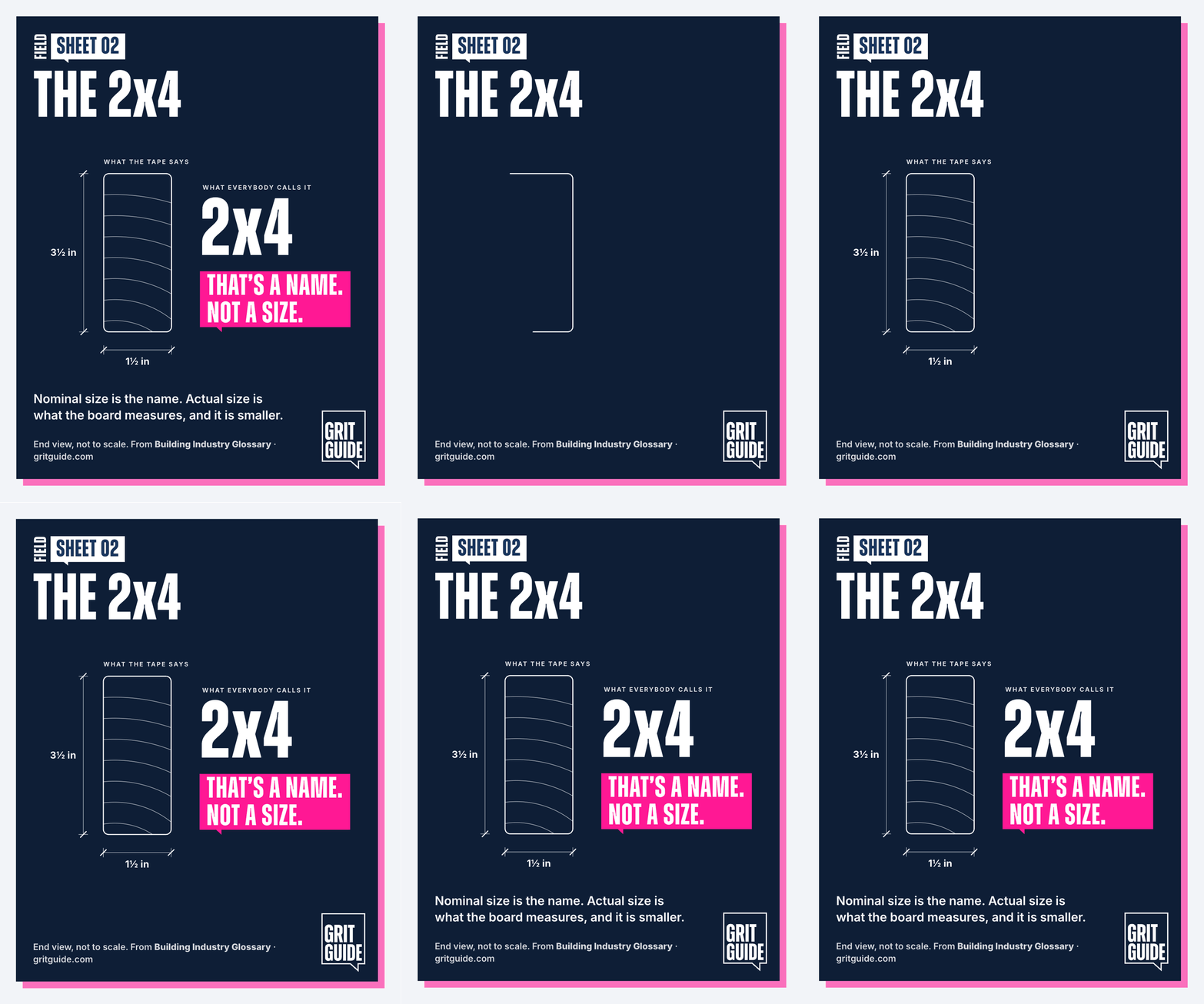
Nominal size is the name of a lumber size, like 2x4. Actual size is what the board really measures, which is smaller. A 2x4 measures about 1½ inches by 3½ inches.
You will hear it like this: “It’s called a 2x6, but put a tape on it.”
Linear foot and board foot
A linear foot is one foot of length, however wide or thick the piece is. A board foot is a measure of volume: a piece 1 inch thick, 12 inches wide and 12 inches long.
You will hear it like this: “Trim is priced by the linear foot. That hardwood is priced by the board foot.”
Treated lumber
Wood treated with a preservative so it resists rot and insects. People also say “pressure treated.” It is not the same as fire-retardant treated wood.
You will hear it like this: “Does he want the deck framing in treated?”
Engineered lumber
Structural wood made in a factory by bonding thin sheets of wood, strands or boards together. LVL (laminated veneer lumber) and I-joists are two you will hear often. Sizes come from the plans, never from a guess.
You will hear it like this: “The floor is I-joists with an LVL beam down the middle.”
Plywood and OSB
Both are wood panels, usually sold by the sheet. Plywood is thin layers of wood glued with the grain crossed. OSB (oriented strand board) is wood strands bonded in layers.
You will hear it like this: “Is he using plywood or OSB on the roof?”
Stud, joist and header
A stud is an upright piece in a wall frame. A joist is one of the level pieces that hold up a floor. A header spans the top of a door or window opening.
You will hear it like this: “What size header do the plans show over that patio door?”
Windows and doors
Rough opening (RO)
The framed hole in the wall where a window or door goes. It is larger than the unit so there is room to set the unit straight. The manufacturer’s size chart lists the rough opening for each unit.
You will hear it like this: “Is that the door size or the rough opening?”
Slab and prehung
A slab is the door by itself, with no frame. A prehung door comes already hung on hinges in its frame.
You will hear it like this: “Does he want just the slab, or a prehung unit?”
Jamb
The pieces that form the frame of a door or window. A door frame has two side jambs and a head jamb across the top. On a door order, jamb width is matched to the thickness of the wall.
You will hear it like this: “What’s the jamb width? Is that a 2x4 wall or a 2x6 wall?”
Handing
Which way a door swings: left hand or right hand, in or out. Manufacturers do not all describe it the same way, so use the diagram on the order form.
You will hear it like this: “Before I order it, show me the swing on the diagram.”
Sash
The part of a window that holds the glass. A sash can move or stay fixed.
You will hear it like this: “The bottom sash won’t stay up.”
Glazing
The glass in a window or door. An insulating glass unit (IGU) is two or more panes sealed together with a space between them.
You will hear it like this: “That unit comes with double-pane glazing.”
Low-E glass
Glass with a very thin coating that slows heat from passing through it. Low-E does not mean tinted.
You will hear it like this: “Does that quote include Low-E glass?”
U-factor
A rating of how fast heat passes through a window, door or skylight. A lower number means less heat gets through. You will find it on the NFRC label on the unit.
You will hear it like this: “The plans list a U-factor for the windows. Does this one meet it?”
R-value
A rating of how well a material resists heat flow. You see it most on insulation. A higher number means more resistance. So for R-value higher is better, and for U-factor lower is better.
You will hear it like this: “What R-value do the plans call for in the attic?”
Millwork
Millwork
A broad word for finished building products that come from a mill or shop, such as mouldings, trim, doors and stair parts. Stores draw the line in different places, so ask what your millwork department covers.
You will hear it like this: “Doors and trim? That’s the millwork desk.”
Moulding and profile
A moulding is a shaped strip used as trim. Also spelled “molding.” The profile is its shape when you look at the cut end.
You will hear it like this: “Bring me a piece so I can match the profile.”
Casing, base and crown
Casing is the trim around a door or window opening. Baseboard, or base, runs along the wall at the floor. Crown runs where the wall meets the ceiling.
You will hear it like this: “I need casing for six doors and base for the whole first floor.”
The channel
Manufacturer, distributor and dealer
The manufacturer makes the product. The distributor buys it and resells it wholesale to dealers. The dealer, such as a lumberyard, sells it to builders, contractors and homeowners. When a distributor sits in the middle like this, the route is called two-step distribution. LBM is short for lumber and building materials.
You will hear it like this: “We don’t buy that line direct. It comes through our distributor.”
Co-op and buying group
An organization independent stores join so they can buy together and share services. A co-op is owned by its member stores. Not every buying group is a co-op.
You will hear it like this: “We buy our hardware lines through the co-op.”
Manufacturers’ rep
A person or firm that represents a manufacturer’s products in a territory and helps dealers and distributors sell them. A rep helps with the sale and is usually not the seller.
You will hear it like this: “Call the rep. She can tell us if that option is available.”
Drop ship
An order shipped straight from the supplier to the customer or the job, without passing through the seller’s own stock. The seller still sold it and still bills it.
You will hear it like this: “That load is a drop ship from the mill, so it won’t come through our yard.”
What to do next
Keep this page open on your phone for your first two weeks. When you hear a word that is not here, write it down the way you heard it and ask someone that day. For how the companies in the last group fit together, read How the Building Industry Works.
Then read Your First 30 Days at a Building Materials Dealer for what to learn in what order. For the product words in more depth, go to Windows 101, Doors 101 and Millwork 101.