Choice Overload: Why a Wall of Options Can Sell Less
A bigger display draws a crowd. A smaller set of options often makes the sale. Choice overload hits hardest when the buyer does not know what she wants, which is most homeowners in a paint aisle or a window showroom.

Choice overload is what happens when too many options make a buyer put off the decision, choose nothing, or feel worse about what she picked. It is real, but it does not happen every time. It hits hardest when the buyer does not know what she wants. That describes most homeowners in a paint aisle or a window showroom. The fix is to ask first and show fewer.
A.J. Ernst is director of sales at The Wooster Brush Company. He sees it on the applicator wall in every store his team serves:
When you’re looking at this 24 feet, 40 feet of paintbrushes and rollers, it’s very overwhelming at times, and you’re not sure what to do.
 A.J. ErnstDirector of Sales, The Wooster Brush CompanyFrom our interview, 4:55
What did the jam study find?
Sheena Iyengar and Mark Lepper set up a tasting booth at Draeger’s, a grocery store in Menlo Park, California, known for carrying over 300 kinds of jam (Journal of Personality and Social Psychology, 2000). On some days the booth showed 24 flavors of Wilkin & Sons jam. On others it showed 6.
The big display drew more people. At the big one, 60 percent of passing shoppers (145 of 242) stopped. At the small one, 40 percent (104 of 260) did. The small display sold more. Nearly 30 percent of the people who stopped at the 6-jam booth bought a jar. At the 24-jam booth, 3 percent did.
Our take: the big display drew the crowd. The small one made the sales.
Does more choice always sell less?
No, and that matters before you tear out an aisle. In 2010 Benjamin Scheibehenne, Rainer Greifeneder and Peter Todd pooled 63 conditions from 50 experiments with 5,036 people. The average effect of more choice was virtually zero, with big differences between studies.
In 2015 Alexander Chernev, Ulf Böckenholt and Joseph Goodman pooled 99 observations from 7,202 participants and found when overload shows up. Four things drive it:
- How complex the options are. Windows are the textbook case. Stefanie Couch is Grit Guide’s host. She listed the layers on a visit to Tucker Door & Trim: “And now you’ve got interior one color and exterior another and cap stock and laminate and all these options.” (10:13).
- How hard the decision is. Measurements, a deadline, a spouse who has to agree.
- How unsure the buyer is about what she wants. A homeowner who has never bought a roller cover has no way to rank 40 feet of them.
- Whether the buyer wants to spend little effort. A contractor between jobs wants the right answer fast, not a tour.
When those four are high, more options hurt. When the buyer knows exactly what she wants, a deep selection is the reason she came to you.
Our take: keep the wall. Shrink the decision.
How do the pros narrow a wall of options?
Wooster asks before it shows
Ernst’s answer to the overwhelming aisle is questions, not fewer brushes: “it all starts with asking the proper questions when the employee engages the consumer” (4:55). Inside or outside, what coating, what finish. Grit Guide laid out his three questions in Three Questions That Point a Customer to the Right Paintbrush.
Tiers help only if the staff can explain them. “There is a good, better, best model, but I think you have to understand what that actually means.” he says (11:26). Wooster also fits the wall to the store: “We have a lot of customizable planograms to get the product selection right for you,” Ernst says of its sales team (4:21). A planogram is the drawing that says which products go where on a shelf.
Lummus Supply puts two choices side by side
At Lummus Supply in Atlanta, CEO Will Lummus walks visitors past decking from two brands, built out “to show you the two different choices” (8:46). The comparison is physical:
You get to walk on it, touch it, feel it, tap dance on it.
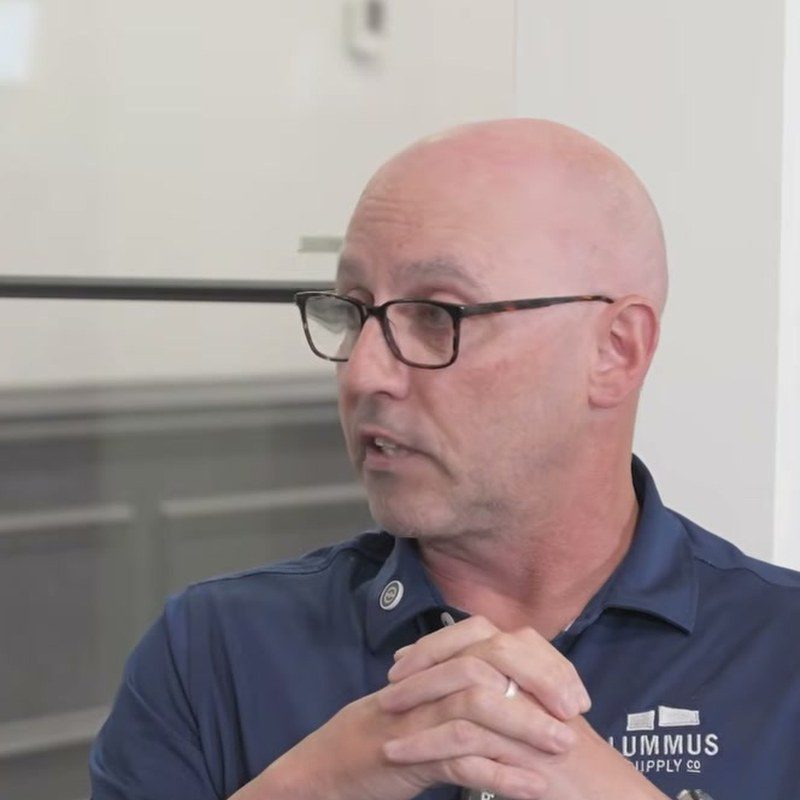 Will LummusCEO, Lummus SupplyFrom our interview, 8:46
Builders bring their homeowners in to choose. “We have builders who bring their clients here so we can go over their engineered wood plans, go over their windows and doors.” Lummus says (8:06). The builder narrows the job. The showroom narrows the products. The homeowner chooses between things she can stand on. For more on building that kind of room, read Build a Showroom Your Contractors Can Send Their Clients To.
Three moves for dealers, manufacturers and reps
- Ask before you show. Two or three questions about the job decide most of the choice. Ask where it goes, what it has to survive and what the customer wants it to look like. Write them on a card at the counter.
- Show two or three, each with a reason. Good, better, best works when each tier is tied to the customer’s job, such as one for a rental and one for her own kitchen, rather than to a price alone.
- Make the comparison physical. Put the two finalists side by side: two doors on hinges, two deck boards, two window corners. Manufacturers can help dealers. They can send fewer, better-chosen samples and a planogram fit to the store’s market.

Our take: ask first, then show two or three
Get curious before you get convincing. A customer’s first request only tells you part of what she needs. A catalog walk-through answers questions she has not asked yet. Learn the job, what matters and what has gone wrong before. Then make a clear recommendation and give one alternative. Product knowledge is only useful when it helps someone choose. New salespeople often learn product names before they learn the questions that make an order complete. Teach the questions first.
What to do next
- Pick the busiest decision in your store or showroom: paint applicators, entry doors, deck boards, window colors.
- Write the two or three questions that narrow it. Train every person on the counter to ask them first.
- For each common answer, choose the two or three products you would show. Write one sentence on why each fits.
- Set up one side-by-side comparison customers can touch.
- Before the next homeowner meeting, read Ask Why Before You Walk a Customer to the Product.
Part of Grit Guide’s series on why buyers do what they do. Also read regret aversion and social proof.
The jam was the same at both booths. Only the number of jars changed.
Questions people ask
What is choice overload?
It is when a large set of options makes people put off a decision, choose nothing, or feel less sure about what they chose. It shows up most when the options are complex and the buyer does not know what she wants.
What did the jam study find?
In Iyengar and Lepper’s 2000 study at Draeger’s in Menlo Park, California, a display of 24 jams drew more shoppers than a display of 6, but about 30 percent of those who stopped at the 6-jam display bought a jar, against 3 percent at the 24-jam display.
Does more choice always mean fewer sales?
No. A 2010 meta-analysis of 50 experiments found an average effect of virtually zero with large differences between studies. A 2015 meta-analysis found overload depends on four things: how complex the options are, how hard the decision is, how unsure the buyer is about what she wants, and whether she wants to spend little effort.
How should a dealer use good, better, best?
As a short list the salesperson can explain, not as three price points on a shelf. A.J. Ernst of Wooster says you have to understand what each tier actually means, and tie each one to the customer’s job.

Watch the full interviews
3 Questions That Help Customers Pick the Right Paintbrush with A.J. Ernst, The 101-Year-Old Company Behind Atlanta’s Finest Luxury Homes with Will Lummus, and Sales Makes the Promise. Operations Keeps It. at Tucker Door & Trim. Times in parentheses mark where each quote sits in the audio episode.
A.J. Ernst, Director of Sales at The Wooster Brush Company, gives store employees two or three questions that point a customer to the right paintbrush or roller cover, and explains why a store with no paint department should still carry applicators.
A Grit Guide original. This piece is built from our own interview.
Episodes in this piece
- Sales Makes the Promise. Operations Keeps It. | Ron Herrin & Lee Allen, Tucker Door and Trim
With Ron Herrin and Lee Allen
- The 101-Year-Old Company Behind Atlanta's Finest Luxury Homes | Lummus Supply Co
With Jennifer Holle, Juwan McKnight, Kevin Scussel, Reid Lummus, Robert King, Todd Gwinn and Will Lummus
Sources
- When Choice is Demotivating: Can One Desire Too Much of a Good Thing? (Sheena S. Iyengar, Mark R. Lepper), Journal of Personality and Social Psychology 79(6), 995-1006, 2000 University of Washington course copy (PDF)
- Can There Ever Be Too Many Options? A Meta-Analytic Review of Choice Overload (Benjamin Scheibehenne, Rainer Greifeneder, Peter M. Todd), Journal of Consumer Research 37(3), 409-425, 2010 Archive ouverte UNIGE
- Choice Overload: A Conceptual Review and Meta-Analysis (Alexander Chernev, Ulf Böckenholt, Joseph Goodman), Journal of Consumer Psychology, 2015 Kellogg School of Management
- 3 Questions That Help Customers Pick the Right Paintbrush (A.J. Ernst, The Wooster Brush Company) (Grit Blueprint Podcast; quotes at 4:55, 4:55, 11:26, 4:21) Grit Guide, Grit Blueprint Podcast
- The 101-Year-Old Company Behind Atlanta's Finest Luxury Homes (Lummus Supply Co.) (Grit Blueprint Podcast; quotes at 8:46, 8:46, 8:06) Grit Guide, Grit Blueprint Podcast
- Sales Makes the Promise. Operations Keeps It. (Ron Herrin and Lee Allen, Tucker Door & Trim) (Grit Blueprint Podcast; quotes at 10:13) Grit Guide, Grit Blueprint Podcast
Sponsorship The interview with A.J. Ernst was recorded for an episode sponsored by Wooster Brush.