A Patio Door That Slides, Swings, Folds or Pivots: Questions to Ask First
Where the panels go when the door is open decides the product, the track, the floor and the order.

In this lesson9 sections
- Sliding doors: what do OX and XO mean?
- What is under a large sliding door?
- Folding doors: where does the stack go?
- Patio door types that swing: hinged and pivot
- Who installs it?
- Decide where the panels go before you price the door
- What to ask the customer
- What stays product-specific
- What to do next
From the episodeHow Custom Luxury Windows And Doors Are Made: Behind The Build at Panda Windows & Doors in Las Vegas

Where the panels go when the door is open decides the product, the track, the floor and the order.
There are four common patio door types, named for how they open: doors that slide, doors that swing on hinges, doors that fold and doors that pivot. The way a door opens decides where its panels sit when it is open, what the track or sill under it looks like, how the unit is written on the order and how much the installer has to plan. So ask first where the panels go. Brand and price come after.
This lesson walks through each type with our own footage from the plant floor at Panda Windows & Doors in Las Vegas and the makers’ own published definitions. Hinged patio doors use LH or RH for the hand and IS or OS for the swing, read from outside the home looking in. The Left-Hand or Right-Hand Door? lesson explains how.
| Type | What moves | Where the panels go | First question |
|---|---|---|---|
| Sliding (gliding), including multi-slide and lift-and-slide | Panels roll along a track | Behind a fixed panel, in a visible stack, or into a wall pocket | Which panels move, and where do they park? |
| Hinged (French) | One or two doors swing on hinges | Into the room or out onto the deck | Inswing or outswing, and what is in the way? |
| Folding (bifold) | Linked panels fold at their joints | Gathered in a group at one or both sides | Where does the folded group sit, and is there a swing panel for daily use? |
| Pivot | One large panel turns on a pivot point | Partly in, partly out, around the pivot | How heavy is it, and who installs it? |
General descriptions. Configurations, panel counts and sizes belong to each manufacturer and product line.
Sliding doors: what do OX and XO mean?
Andersen’s glossary defines a gliding or sliding door as a “door with two or more panels where one panel slides horizontally past another.” The same glossary explains the code you will see on every sliding door order: “X” stands for operating while “O” stands for stationary. So XO and OX describe the same door with the moving panel on opposite sides. Andersen also says hinged window and door handing is determined by the hinge location “as viewed from exterior.” Always read exterior handing from outside the home looking in. If a maker’s drawing seems to show another side, ask before you order.
Sliding doors also come with parts customers forget to ask about. Andersen’s glossary lists a foot lock, an “auxiliary lock used on gliding doors to secure the operating panel to the sill,” and a top hung insect screen for patio doors. Ask whether the screen and any extra lock are included or separate lines.
Lift-and-slide, multi-slide, stacking and pocketing
These words describe different things, and one door can be several of them at once.
- Multi-slide: several straight panels that roll along tracks. One maker’s range includes straight-stacking, bi-parting, pocketing and corner configurations.
- Lift-and-slide: hardware that lifts a panel off its seals to move it and lowers it to seal when closed. Loewen describes it this way: “The Lift & Slide system temporarily disengages panels from the weatherstrip, allowing them to roll effortlessly regardless of size.”
- Stacking: the open panels sit in a visible group.
- Pocketing: the open panels slide into a recess built into the wall, out of sight.
- Bi-parting: the panels open from the middle toward both sides.
So “lift-and-slide, pocketing” on a quote is not a contradiction. One word is the mechanism, the other is where the panels park. At Panda, most of these are big units. Noya Shoshan, Director of Operations at Panda Windows & Doors, stood beside a seven-panel TS19 lift-and-slide on the plant floor and said:
Most of our jobs are four panels upwards. Very rarely do we see ones that are smaller than that.
 Noya ShoshanDirector of Operations, Panda Windows & Doors (9:05)
See it in An Inside View of Panda’s TS19 Lift & Slide Door.
What is under a large sliding door?
A track and a sill, and they shape the floor. In the track room at Panda, Noya explained the choice every large slider raises:
We have several different types of tracks. Some are surface, some are recessed.
Noya ShoshanDirector of Operations, Panda Windows & Doors (7:01)A surface track sits on top of the floor. A recessed one goes down into it so the walk is flush. Loewen’s page for its lift-and-slide describes a flush track that “allows flooring to be installed between the tracks.” On the test wall, Noya pointed out the drainage track that carries water out before it reaches the threshold. Watch it in What a $150k Door Looks Like.
For the counter, the point is timing. A recessed track or a wall pocket has to be planned with the builder before the floor and the wall are built. Ask early, and write down who is designing that detail.
Folding doors: where does the stack go?
Andersen defines a folding door as a “door unit with multiple hinging panels that can be folded together to create an large, unobstructed opening.” The folded panels have to sit somewhere, and makers offer different ways to park them. Noya described one of Panda’s:
Our folding doors have different parking options. You can either fold the normal conventional way, or we have the Y header and Y track, which allows you to fold around the corner.
Noya ShoshanDirector of Operations, Panda Windows & Doors (10:06)Two more questions belong on every folding door quote. Is the weight carried at the top or the bottom? Loewen says of its bifold: “The weight of the panels is carried at the head, which is unique to this product.” And how will people go in and out every day? Loewen says many of its bifold configurations allow an operating panel “that acts like a hinged swing door,” so nobody has to open the whole wall to let the dog out. Those are one maker’s features, which is exactly why you ask.
Folding is not only for doors. At The Liquidators Company’s showroom we filmed an aluminum bi-folding window. It is sold for spots like a kitchen sink or a bar.
Patio door types that swing: hinged and pivot
Andersen describes a French door as hinged doors with a large glass area, wide side stiles and a tall bottom rail. A pair works like an entry pair: one active door, one that stays latched until it is needed. The sidelites and transoms lesson covers astragals and bolts.
A double patio door can be jamb hinged or center hinged. Some people call jamb hinged “end hinged.” Either one can be LH or RH and IS or OS, like LHIS jamb hinged or LHIS center hinged.
Patio door handing is one of the most confusing and error-prone parts of millwork ordering. Go slow. Always check the maker’s handing chart, and use actual CAD drawings (detailed computer drawings) when you can.
A fixed patio panel is permanently fixed, like a window. It will never open. A double door with an astragal is different. The astragal is on the inactive door, and that door opens when you release the head and foot bolts. A triple or quad patio door will have more than one inactive or fixed door.
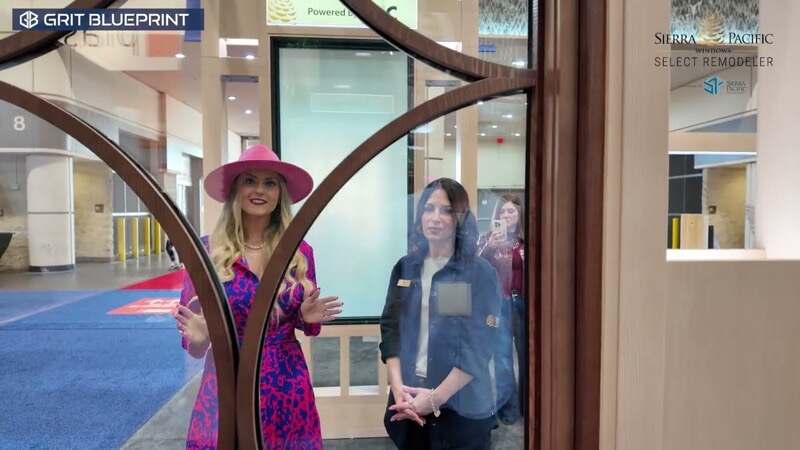
A pivot door turns on a pivot instead of hinges on its edge. On the Panda floor, Noya showed the frame inside one of their pivot doors before it was skinned. Stefanie Couch of Grit Blueprint said what a lot of customers are thinking:
Pivot doors are so big right now and they're really cool, but they're also very functional, because it allows you to have something this big without having to have a huge area.
 Stefanie CouchGrit Blueprint, at Panda Windows & Doors (15:55)
Big means heavy. In the hardware room, Noya told us about a recent unit with panels of 2,000 pounds each, crated one panel to a box. Ask about weight, handling and the installer before the order goes in. See the build in How Voyage Pivot Doors Are Built From the Skeleton Up.
Who installs it?
Large patio systems are not a homeowner project. When Stefanie asked about installation, Noya answered:
We recommend installers. We have our installation manuals.
Noya ShoshanDirector of Operations, Panda Windows & Doors (14:19)Panda also assembles each door on a test wall in the plant and checks measurements, locks and latches before it ships. Ask any maker you sell what it checks before shipping and what the installer receives.
Decide where the panels go before you price the door
Multi-panel folding and pocketing systems come with three rules. They have to be designed into the plans from the start, not added when the framing is done. They need a professional installer. And before anything else, find the panel people will actually use and confirm the whole layout on the manufacturer’s drawing.
So decide where the panels go before you price the door. Write the configuration in words, then in the maker’s code. Mark the floor, the pocket and the header as the builder’s decisions with a name next to each.
What to ask the customer
“When the door is open, where do you want the panels: behind each other, stacked at the end, folded to the side or out of sight in the wall? How will you use it on an ordinary day? Should the track be flush with the floor, and is the floor finished yet? Does it open in or out? Do you need screens? Who is the builder, and who is installing? Is the opening framed yet, or can it still change?”
Checklist: before you quote a patio door
Go down this list before you quote a patio door. Any box you can’t tick is the step to go back to.
0 of 10 ticked
What stays product-specific
Panel counts, maximum sizes, track types, how panels park, codes and viewing sides, weights, screens, hardware and every performance rating belong to the manufacturer and the exact configuration. A rating for one configuration does not carry to a bigger or different one. How to Read a Window and Door Order shows how to check the configuration line when the order comes back.
What to do next
Find the patio door catalog your store sells most. Find one sliding door code and say out loud which panel moves, from which side. Then find one folding or multi-slide configuration and draw, from above, where the panels sit when it is open.
Watch the full Behind The Build at Panda Windows & Doors. If the glass words are next, read Tempered, Laminated, or Insulating Glass. New words are in the Building Industry Glossary.
Questions people ask
What does OX or XO mean on a sliding patio door?
It tells you which panel moves. In Andersen’s glossary, X stands for operating and O for stationary, so XO and OX are the same door with the moving panel on opposite sides. Read the code from the viewing side the manufacturer names, and confirm it on its drawing.
What is the difference between a sliding door and a lift-and-slide door?
Both have panels that roll along a track. On a lift-and-slide, the handle lifts the panel off its seals so it can roll, then lowers it so it seals again when closed. One maker describes it as temporarily disengaging the panels from the weatherstrip.
What is the difference between stacking and pocketing?
Both describe where sliding panels park when the door is open. Stacking leaves the panels in a visible group at one or both ends. Pocketing slides them into a recess built into the wall so they are out of sight, which has to be planned in the framing.
Can a folding patio door have a regular door in it?
Some can. One maker says many of its bifold configurations allow one panel to work like a hinged swing door, so people can go in and out without opening the whole wall. Ask whether the line offers it and in which configurations.
Who should install a large sliding, folding or pivot door?
An installer who knows that system and has its installation manual. The Director of Operations at Panda Windows & Doors told us they recommend installers and support them with manuals and troubleshooting. Put the installer on the job before the order is final.
Episodes in this piece
- How Voyage Pivot Doors Are Built From the Skeleton Up at Panda Windows & Doors: Behind The Scenes
With Dori Shoshan and Noya Shoshan
- An Inside View of Panda's TS19 Lift & Slide door | Panda Windows & Doors
With Dori Shoshan and Noya Shoshan
- How Custom Luxury Windows And Doors Are Made: Behind The Build at Panda Windows & Doors in Las Vegas
With Dori Shoshan and Noya Shoshan
- What a $150k Door Looks Like – Assembling A Lift & Slide Door On An Enormous Test Wall with Panda
With Dori Shoshan and Noya Shoshan
- Imagine This Amazing Aluminum Bi-Folding Window In Your House, Open Up Your Space Instantly
With Bridget Roland
Sources
- Window and Door Glossary (gliding door, OX / XO, folding door, French door, foot lock, handing) Andersen Windows & Doors
- LiftSlide Loewen
- MultiSlide Loewen
- BiFold Loewen
- How Custom Luxury Windows And Doors Are Made: Behind The Build at Panda Windows & Doors in Las Vegas Grit Guide