Your First 30 Days at a Building Materials Dealer
A week-by-week plan for new hires at a dealer, yard or counter, with checklists and words to use.


In this lesson4 steps
- Step 01Week 1: Learn the building, the yard and the people
- Step 02Week 2: Learn the top products and the questions
- Step 03Week 3: Learn how orders, special orders and deliveries work
- Step 04Week 4: Meet your first accounts and keep your own notes
From the episodeMarion Pulse on Confidence, Patience and Finding Your Place in Fenestration

A week-by-week plan for new hires at a dealer, yard or counter, with checklists and words to use.
You got the job. Now there is a yard full of products you cannot name and a computer system nobody has time to explain. And there are customers who have been building houses longer than you have been alive.
Nobody learns this business in a month. You can learn it in the right order. This plan is for you, the new hire at a lumberyard, a hardware store or a dealer’s counter. If your manager has a training plan, follow it and use this to fill the gaps. If there is no plan, bring this one.
A notebook with your own map of the yard, the top products and the questions for every order. Add a few customers you know by name and a page of notes for each week.
- A pocket notebook you will carry every day
- The name of one person you can ask anything
- Your company’s safety rules for the yard and the warehouse
You are allowed to not know yet
Marion Pulse started in window and door sales at Pella straight out of graduate school. On a Grit Guide episode she says she spent her first year at the corporate office, learning basic words like sash and frame, seated next to her mother, who had worked there more than twenty years. She says she got to learn without feeling dumb. In her second year in the field she made President’s Club.
Most new hires do not get a year. Her advice still works on day one: be patient with yourself and tell the truth when you do not know. In her words, “It’s okay to say, I don’t know, and I’ll find the answer for you.”
She also warns that some people will try to make you feel dumb. Her answer is the same. It takes time, so give yourself the time.
Step 1: Week 1: Learn the building, the yard and the people
Ask for the yard safety rules before you walk anywhere. Your company decides where you can go and what you must wear.
Then walk the whole place with someone who knows it and draw a rough map. Mark where deliveries come in (receiving) and where paid orders wait for pickup (will call).
Find out what your company makes, on top of what it sells. Some dealers run a door shop or a millwork shop, where doors and trim are made. Magbee Contractors Supply in Georgia builds custom wood doors in a shop at the heart of its yard. See it in Behind the Build at Magbee Contractors Supply.
Learn people as carefully as products. Write down each name and what that person is the go-to for. Stefanie Couch gives managers a question to ask their teams. Borrow it: “What’s the hardest customer situation you’ve faced, and how did you handle it?” (From Your Building Industry Training Strategy: “Sink or Swim” Isn’t a Strategy.)
Week 1 checklist
Tick these off during week 1. Any box you can’t tick is the step to go back to.
0 of 5 ticked
Step 2: Week 2: Learn the top products and the questions
You cannot learn every product in the building. Ask your manager which items go out the door most, and start there. For each one, learn what it is for, where it is and how it is sold: each, by the foot, by the sheet or by the bundle.
Then learn the five questions that keep an order from going wrong.
- What is it for?
- What size, and how did you measure?
- How many?
- When do you need it?
- Pickup or delivery, and where?
Write each new trade word down the way you heard it. Then look it up in the Building Industry Glossary. For the big product groups, read Windows 101, Doors 101 and Millwork 101.
Week 2 checklist
Tick these off during week 2. Any box you can’t tick is the step to go back to.
0 of 4 ticked
Step 3: Week 3: Learn how orders, special orders and deliveries work
Ask to shadow two orders from start to finish.
The first is a stock order, for something on the shelf or in the yard. Watch it get written up, pulled, loaded and either picked up or delivered.
The second is a special order, for something your store does not stock and orders for one customer. Follow it from the quote (the written price) to the purchase order your store sends its supplier, then to the acknowledgment, which is the supplier’s written version of what it thinks you ordered.
Read the acknowledgment against the quote line by line. On doors, details that often get missed are which way the door swings, the width of the jamb (the frame) and the sill at the bottom. The Window and Door Order Checklist covers the rest.
Learn your store’s rules on deposits and returns. Find out who tells the customer when the lead time, the wait for the product to arrive, changes. Then ask how a delivery gets on the schedule. Also ask what the driver needs to know about the site. If your company allows it, ride along once.
Week 3 checklist
Tick these off during week 3. Any box you can’t tick is the step to go back to.
0 of 5 ticked
Step 4: Week 4: Meet your first accounts and keep your own notes
Ask your manager for three to five accounts to get to know. An account is a customer who buys from you again and again. For each one, find out what they build and who places their orders. Also find out what has gone wrong before.
Then introduce yourself. Marion Pulse describes the first big meeting in one of her jobs, where she walked up to every table at lunch and said hello so people would have a friendly person to call. At the counter it sounds like this: “I’m new here. I’m learning your account, and I want to get your orders right.” For more on names and fast follow-up, watch Building a Million Dollar Network.
When you say you will call back, call back, even if the answer is “I’m still waiting on it.” Customer Follow-Up Scripts has words you can borrow.
Keep one page of notes per week. One habit from the episode with Marion: write down every week what you are working on, how it is going and what you need to get better at. Bring those pages to a 30-day talk with your manager. Do not assume your boss already knows what you have learned.
Week 4 checklist
Tick these off during week 4. Any box you can’t tick is the step to go back to.
0 of 4 ticked
Finish line
You should now have: A notebook with your own map of the yard, the top products, the questions for every order, a few customers you know by name and a page of notes for each week.
What to say when you do not know
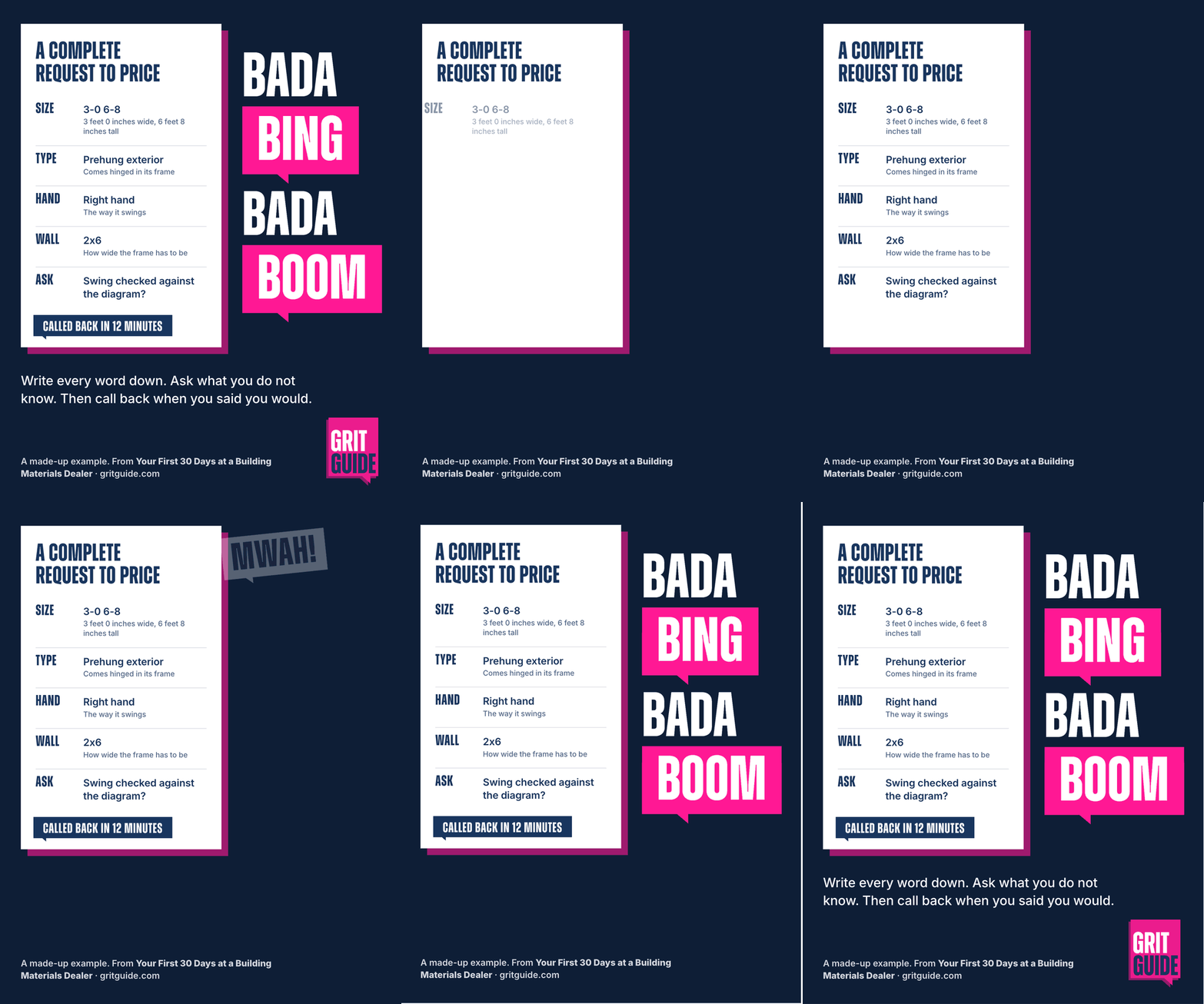
Every day for a while, someone will ask you something you cannot answer. A guess can turn into a wrong order. Say this instead.
- At the counter: “I don’t know yet. I’m new, and I’d rather get you the right answer than a fast one. Give me five minutes.”
- On the phone: “I want to check that before I tell you wrong. Can I call you back by two o’clock? What’s the best number?”
- To a coworker: “A customer asked me this and I promised a call back by two. Who knows the answer, and can I listen while you explain it?”
Then call back when you said you would. Write the question and the answer in your notebook.
What to do next
Day 30 is a checkpoint. Go through the four checklists with your manager and pick the next product group to learn. If your manager wants a plan for their side, send them How to Get a New Counter Hire Ready in Two Weeks.
Next on your own list: the Window and Door Order Checklist for your first special orders and Customer Follow-Up Scripts for the calls you promised to make.
Disclosure: Marion Pulse is now Client Success Director at Grit Blueprint, which publishes Grit Guide. Her words here come from her 2024 Grit Blueprint Podcast interview, recorded while she was at NFRC.
Episodes in this piece
- Marion Pulse on Confidence, Patience and Finding Your Place in Fenestration
With Marion Pulse
- How a 70 Year Old Millwork Shop Operates: Behind The Build at Magbee Contractors Supply
With Stewart Brandon, Bob Magbee and Melissa McDougald
- Building a Million Dollar Network: How to Make Better First Impressions With Confidence
With Ben Couch
Sources
- Marion Pulse on Confidence, Patience and Finding Your Place in Fenestration (episode) (December 2024) Grit Guide
- Your Building Industry Training Strategy: “Sink or Swim” Isn’t a Strategy, by Stefanie Couch Grit Blueprint
- How a 70 Year Old Millwork Shop Operates: Behind The Build at Magbee Contractors Supply Grit Guide
- Building a Million Dollar Network: How to Make Better First Impressions With Confidence Grit Guide