TFL, HPL, MDF, or Plywood: What Is a Cabinet Panel Made Of?
Every cabinet and closet panel is a face on a core. The customer picks the face. You need to know the core.
In this lesson8 sections
- What is TFL?
- TFL or HPL: what is the difference?
- Particleboard, MDF, or plywood: what is under the face?
- What should you know about cabinet and closet panels?
- Sell the look, then write down the core
- What to ask the customer
- What stays product-specific
- What to do next
From the episodeThermally Fused Laminate Explained: What’s New at IWF 2026 | Ft. Arauco at IWF 2026 in Atlanta
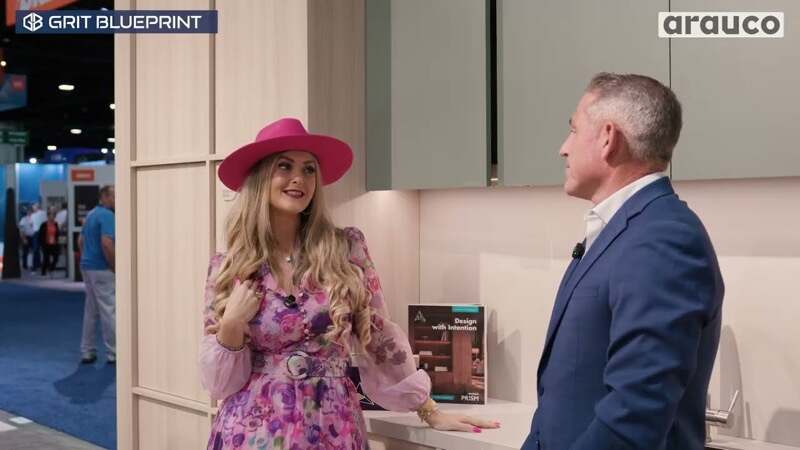
Every cabinet and closet panel is a face on a core. The customer picks the face. You need to know the core.
A cabinet or closet panel is two things: a face and a core. The face is what the customer sees and touches, such as a laminate, a wood veneer, or paint. The core is the board under it, such as particleboard, MDF, or plywood. The core decides the weight, how the panel holds screws, and where it may go. A white closet shelf and a white cabinet door can look alike and be built very differently. So name both layers before you quote.
This lesson covers the panels that go into cabinets, closets, shelving, and furniture: what TFL is, how it differs from HPL, and the three common cores under them.
What is TFL?
TFL stands for thermally fused laminate. At the Arauco booth at the International Woodworking Fair (IWF) 2026 in Atlanta, Cathy Hummer, senior manager of TFL development and design at Arauco North America, told us how it is made in our video Thermally Fused Laminate Explained.
It is a product that is made by saturating a decorative paper with a melamine resin, and that melamine-treated paper is then thermally fused to our particle board or MDF substrates.
 Cathy HummerSenior Manager, TFL Development & Design, Arauco North America (1:55)
In plain words: a printed paper is soaked in resin, then pressed with heat onto a board. The paper carries the color or the woodgrain. The substrate is the board under the face. Panolam, another panel maker, describes its TFL the same way in its technical bulletin. It says both sides of its panels have a finished decorative surface. Many customers call TFL “melamine,” and Panolam’s bulletin calls its own TFL panels melamine panels. For more on how TFL is made and who buys it, read What Is TFL?
The face has a feel, too. Texture is pressed into the surface, so a woodgrain can feel like grain under your hand. Russ Jordan, president of Arauco North America, named texture as one way his company adds value to a panel.
We’re continuing to look at all the new embossed textures, deep texture, all the different designs for decorative surface, to add value to our panel.
 Russ JordanPresident, Arauco North America (5:49)
Who buys TFL tells you what it is for. Jon Minnaert is president of Aetna Building Solutions, a wholesale distributor in the Chicago area that sells Arauco panels. He listed his customers.
So the primary segments that we sell to would be cabinet manufacturing, any sort of case good, store fixtures, closet producers, countertop manufacturers, office furniture.
 Jon MinnaertPresident, Aetna Building Solutions (10:07)
TFL or HPL: what is the difference?
Words to know
The whole glossary- HPL (high pressure laminate)
- A laminate sheet made from several layers, surface papers treated with melamine resin and core kraft papers treated with phenolic resin, fused under high temperature and pressure into one sheet and then applied to a substrate such as MDF. That is how Formica describes it.
- TFL (thermally fused laminate)
- A single decorative paper treated with melamine resin and fused directly to the panel. There is no separate laminate sheet.
The short version: HPL is a sheet that gets glued to a board, and TFL is a paper that becomes part of the board. Formica, which makes both, sums up where TFL fits.
TFL is a value-engineered alternative to HPL in some vertical applications.
A vertical surface stands up, like a cabinet side or a door. A horizontal surface lies flat, like a desk or a countertop. Formica says HPL is made for both, and that TFL is often used for cabinets and office furniture. It also says HPL is the only choice when the laminate has to be postformed, which means bent with heat around a rounded edge.
Panolam’s bulletin goes further for its own TFL: fine for nearly all upright uses and many flat ones, such as desks, with exceptions for high-wear surfaces like kitchen countertops and checkout counters, and for places that may get hotter than 275 degrees Fahrenheit. So when a customer wants a laminate countertop, ask the countertop maker which product it uses.
Particleboard, MDF, or plywood: what is under the face?
| Core | What it is | Ask about |
|---|---|---|
| Particleboard | Wood particles bonded into a panel; a common TFL core | Grade, thickness, and how edges and screws are handled |
| MDF | Medium-density fiberboard: fine wood fibers bonded into a dense, smooth panel; also a TFL core | Moisture rules from the maker, thickness, and weight |
| Plywood | Thin layers of wood veneer, the grain of each layer crossing the next, bonded under heat and pressure (APA’s description) | Face species and grade, thickness, and whether it is sanded, primed, or patterned |
Plain descriptions for the counter. Strength, moisture, and emissions belong to the exact product and its standard.
Panolam lists industrial-grade particleboard and MDF as its TFL substrates, and says fire-retardant and moisture-resistant panels are available too. So ask which core a line uses before you promise where it can go. Plywood is built differently: APA, the engineered wood association, describes it as thin layers of cross-laminated wood veneer bonded under heat and pressure.
Arauco’s booth showed how many choices hide under one word. Next to the TFL were beaded plywood, plywood with a deeper groove for a T1-11 look, primed plywood, and sanded plywood to finish on site. Minnaert named that range as one reason his company works with Arauco.
The other thing that they have is MDF, plywood, particle board, and TFL, so it diversifies well.
Jon MinnaertPresident, Aetna Building Solutions (9:39)A panel is more than its face. A finished panel may have a face, a core, an edge treatment, and a backer. The backer is the layer on the back that keeps it balanced. Do not specify a panel from its visible face alone.
What should you know about cabinet and closet panels?
A cabinet is a box with fronts. The sides, back, and bottom are the box. The doors and drawer fronts are separate choices, and so are the hinges, slides, and pulls. Framed cabinets have a face frame on the front of the box; frameless cabinets do not. Overlay doors cover the front of the box; inset doors sit inside the opening. A Shaker look, a painted color, and framed or frameless are three separate decisions.
Some parts that look like the cabinet are often their own lines: an exposed end panel, a filler between a cabinet and a wall, the toe-kick finish, and the countertop. And ready-to-assemble describes how the cabinet ships, not how good it is. Closet systems built from TFL panels follow the same rule. Ask what is in the box, what is a separate panel, and who puts it together.
Sell the look, then write down the core
Customers choose panels by look and feel: the texture, the color, the grain. That is where the sale starts. Your job is the second half. Write down the core, the edges, the back, and where the panel is going, because those decide whether it holds up. Stefanie Couch walked the Arauco booth. She pointed at what one good panel can do for a room.
using a product like this as a backdrop can add so much to a room without doing a ton, just adding it to even one wall.
 Stefanie CouchHost, at IWF 2026 (11:59)
What to ask the customer
“Is this for cabinets, a closet system, shelving or a desk? Which room, and does it get wet or hot? Do you want a texture or a smooth face, and which design? Will the edges show, and how should they be finished? Who is cutting and putting it together? Do you have the cabinet or closet maker’s spec for the core?”
Checklist: before you quote a cabinet or closet panel
Go down this list before you quote a cabinet or closet panel. Any box you can’t tick is the step to go back to.
0 of 7 ticked
What stays product-specific
Where a panel may be used, how it holds screws, how much moisture and heat it takes, its emissions, and its warranty belong to the exact product. Laminate grades and core grades come from the maker’s documents and the standards it cites. Performance claims on this page are the makers’, as they stated them.
What to do next
Find three panels in your store: a TFL shelf, a sheet of plywood, and an MDF panel. Look at the edge of each and name the face and the core. Then find the data sheet for the TFL. Read what it says about flat surfaces and heat.
Comparing panel options for a wall instead of a cabinet? Read Trusscore PVC Wall and Ceiling Panels. Trim materials are compared in MDF, Finger-Jointed, Solid Wood or PVC Trim. The whole package comes together in How to Sell Millwork. Every term is in the building industry glossary.
Watch the full booth tour: Thermally Fused Laminate Explained: What’s New at IWF 2026, the two-minute What Is TFL? Arauco’s Designer Explains Thermally Fused Laminate, and Jon Minnaert in What Makes a Great Supplier Partner in Building Materials.
Questions people ask
What does TFL stand for?
Thermally fused laminate. A decorative paper is soaked in melamine resin and fused with heat to a particleboard or MDF panel. Cabinet, closet, and furniture makers use it for boxes, shelves, and doors.
What is the difference between TFL and HPL?
HPL, high pressure laminate, is a separate sheet made from several layers of resin treated paper, and it is glued to a panel. TFL is one decorative paper fused right onto the panel. Formica describes HPL as made for flat and upright surfaces and TFL as an alternative in some upright uses. Panolam lists kitchen countertops among the exceptions for its TFL.
Is melamine the same as TFL?
Many people say melamine when they mean TFL, because the paper is soaked in melamine resin. Panolam’s technical bulletin calls its TFL panels melamine panels. Either way, ask for the core and the thickness.
Is MDF or plywood better for cabinets?
They are different cores, and neither one is a rating by itself. MDF is a dense, smooth fiberboard. Plywood is built from thin layers of wood veneer. The face, the edges, the back, and the way the cabinet is built all matter too. Ask the cabinet or panel maker what core each line uses and why.
Episodes in this piece
- What Makes a Great Supplier Partner in Building Materials | Jon Minnaert of Aetna Building Solutions
With Jon Minnaert
- What Is TFL? Arauco's Designer Explains Thermally Fused Laminate | Arauco at IWF 2026
With Cathy Hummer
- Thermally Fused Laminate Explained: What's New at IWF 2026 | Ft. Arauco at IWF 2026 in Atlanta
With Cathy Hummer, Jon Minnaert, Russ Jordan and Stefanie Couch
Sources
- Thermally Fused Laminate Explained: What’s New at IWF 2026 (at the Arauco booth, IWF 2026, Atlanta). Cathy Hummer, Russ Jordan, Jon Minnaert, and host Stefanie Couch; quotes at 1:55, 5:49, 9:39, 10:07, and 11:59 Grit Guide
- What Is TFL? Arauco’s Designer Explains Thermally Fused Laminate (the two-minute version) Grit Guide
- What Makes a Great Supplier Partner in Building Materials, Jon Minnaert of Aetna Building Solutions (the short version) Grit Guide
- High Pressure Laminate and Thermally Fused Laminate: Understanding the Differences Formica
- Thermofused Laminate (TFL) Technical Bulletin Panolam
- Plywood APA, The Engineered Wood Association
Disclosure The interviews quoted here were recorded at Arauco’s booth at IWF 2026.