Engineered Wood: LVL, LSL, I-Joists and Glulam
Engineered wood is a family of products, each made a different way. A matching depth does not make two of them the same beam.
In this lesson7 sections
- What are LVL, LSL and PSL?
- What is a wood I-joist?
- Glulam: two ratings on one beam
- What goes wrong
- Send the layout and the hole chart with the joists
- What to ask before you quote engineered wood
- What to do next
From the episode1,200 Holes in One I-Joist Plan for a 29,000 Square Foot Luxury Home: Watch the Boise SawTek Run
Engineered wood is a family of products, each made a different way. A matching depth does not make two of them the same beam.
Engineered wood is lumber and panel products made by bonding wood pieces together: veneers, strands or boards. In a house you will meet five of them most: LVL, LSL and PSL for beams and headers, wood I-joists for floors and roofs, and glulam for beams that may show. Each one is made a different way and is ordered by its manufacturer’s name, series and size from a design, never by “a beam about that deep.”
APA, the Engineered Wood Association, groups these products as a family: plywood and OSB, I-joists, glulam, cross-laminated timber, structural composite lumber and rim board. Plywood and OSB have their own lesson, OSB vs Plywood. This one covers the framing members.
What are LVL, LSL and PSL?
They are all structural composite lumber, or SCL: wood pieces bonded into a solid member that is used like a big piece of lumber. APA describes them this way.
| Product | How it is made | Where you will see it |
|---|---|---|
| LVL, laminated veneer lumber | “bonding thin wood veneers with exterior-grade adhesives,” with the veneers “oriented primarily in the longitudinal direction” | Beams and headers, often in long lengths |
| LSL, laminated strand lumber | “flaked wood strands” bonded “into large billets that are then resawn to specified dimensions” | Headers, rim and framing where straight, even sizes matter |
| PSL, parallel strand lumber | Long strands bonded into a beam. One maker sells it as Parallam | Beams and columns |
APA says SCL is used for “beams, headers, columns, and other critical building components.” PSL is described from our Harbin Lumber visit; APA’s SCL page names LVL, LSL and OSL. Suitable uses always come from the product’s own documents.
At Harbin Lumber in Lavonia, Georgia, Westley Harbin traced how the beam rack has changed. A Weyerhaeuser mill about 20 miles away made PSL, sold as Parallam. “Paralams aren’t a big deal anymore,” he said in our visit. Then:
You're starting to see a lot of LSL as well, but a lot of stuff has moved to the LVL world.
 Westley HarbinFourth generation, Harbin LumberFrom our Behind the Build visit, at 25:42
What is a wood I-joist?
A wood I-joist is a factory-made joist shaped like a capital I: a top flange and a bottom flange joined by a tall, thin web. APA says most are made in four depths, “9-1/2, 11-7/8, 14, and 16 inches,” and each depth comes in several series.
Words to know
The whole glossaryThe rest of an I-joist floor has its own parts: rim board around the edge, blocking between joists, hangers, and web stiffeners (wood blocks fastened to the web).
How an I-joist floor is ordered
An engineered floor is designed for one house. Bob Magbee, of Magbee Contractors Supply in Winder, Georgia, showed us the floor-system yard in our Behind the Build visit.
We design the floor systems and we actually cut the holes out for the heat and air systems that go through those I-joists.
The joists arrive long and are cut to length. “There’s different grades of all this stuff,” he said (9:06). “So you might have a wide flange, as well as this flange. And of course, how deep it is has a lot to do with how far you’re spanning.” The design comes from the manufacturer’s software: “We use their software technology where they basically build in all the different spans that these products will do” (9:31).
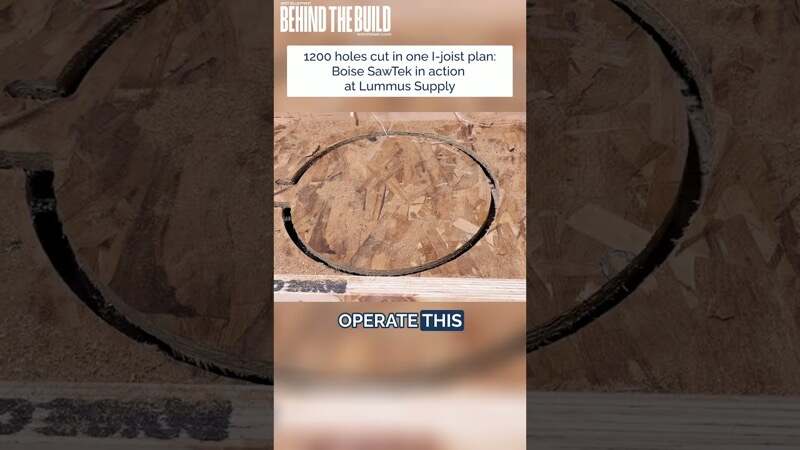
In our short clip of a SawTek machine cutting an I-joist package, you hear it from the floor: “1,200 holes in one I-joist plan, that’s what Todd just told me” (0:17). Watch the SawTek run. Every one of those holes came from the layout.
- The builder sends plans.
- The dealer’s designer, or the manufacturer’s, lays out the floor in the maker’s software: joist series, depth, spacing, beams, rim, blocking, hangers.
- The layout comes back with a material list. That list is the order.
- Holes for ducts and pipes are placed from the layout and the hole chart, sometimes cut at the yard.
- The package ships with the layout. The installer builds from it and the manufacturer’s installation guide.
Glulam: two ratings on one beam
Glulam, glued laminated timber, is a beam made of layers of lumber bonded together. APA says glulam bearing its trademark is made under ANSI A190.1 and can be straight, curved, tapered or arched.
A glulam beam carries two kinds of designation. The structural one says what it can carry. The appearance one says how it looks. APA lists four appearance classes: “Framing (concealed applications only), Industrial (concealed or non-appearance-critical applications), Architectural (exposed applications with a smooth, attractive finish), and Premium.” So an Architectural surface does not by itself tell you what the beam can carry.
What goes wrong
- A same-depth swap. A crew is short a beam and another one in stock is the same depth. Two beams can share a depth and still be different products. Ask your dealer or the designer before any change.
- Long packages and tight sites. At Harbin, the team talked about getting LVL and I-joist packages down lake-lot driveways; one remark on the visit was that some LVL packages run about 40 feet long. Ask about site access when you quote.
Send the layout and the hole chart with the joists
The yards that win engineered floors, as Bob Magbee showed us, do the design work and own the details. He said doing more of it themselves lets them “respond quicker” and “perform better for our customers” (8:33).
At the counter that means the layout, the hole chart and the installation guide go out with the joists, and any change to a beam goes back to the designer. A quick answer that skips the layout is the slow answer once the inspector sees it.
What to ask before you quote engineered wood
“Do you have the plans, and has anyone laid out the floor or the beams yet? Whose design is it: ours, the manufacturer’s or an engineer’s? Which series and depth does it call for? Where do the ducts and drains run? Can a long package get to the site? Is anything on this list a substitute for what the design shows?”
Checklist: an engineered wood order is ready when
Tick each one off. It is not ready until every box is ticked.
0 of 7 ticked
What to do next
Find the installation guide for the I-joist line your yard sells, and see what parts it names. Then look at an LVL beam in the yard and find its stamp: maker, product and size.
Next: How a Roof Truss Order Works. The parts of a framed house and the size labels are in Lumber Sizes, Grades and Stamps.
Questions people ask
What is the difference between LVL and LSL?
Both are structural composite lumber. APA describes LVL as thin wood veneers bonded with exterior-grade adhesives, oriented mainly along the length. LSL is made from flaked wood strands bonded into large billets that are then resawn to size.
Can you cut a hole in an I-joist?
Follow the maker’s instructions, and ask your dealer or the designer. Many dealers cut the holes at the yard from the floor layout, as Magbee Contractors Supply does.
Can I swap one engineered beam for another of the same size?
Ask the designer or your dealer first. Two beams can share a depth and still be different products.
What does Architectural mean on a glulam beam?
It is an appearance class, about how the surface looks. APA lists four: Framing, Industrial, Architectural and Premium. The beam also has a separate structural designation.
Episodes in this piece
- 1,200 Holes in One I-Joist Plan for a 29,000 Square Foot Luxury Home: Watch the Boise SawTek Run
With Todd Gwinn, Jennifer Holle, Juwan McKnight, Kevin Scussel, Reid Lummus, Robert King and Will Lummus
- How a 70 Year Old Millwork Shop Operates: Behind The Build at Magbee Contractors Supply
With Stewart Brandon, Bob Magbee and Melissa McDougald
- Georgia Builders Are Powered By This Fourth Generation Lumberyard | Behind the Build: Harbin Lumber
With Westley Harbin
Sources
- Engineered Wood Products (family overview); Structural Composite Lumber (SCL); I-Joists; Glulam APA, The Engineered Wood Association
- How a 70 Year Old Millwork Shop Operates: Behind The Build at Magbee Contractors Supply Grit Guide
- Georgia Builders Are Powered By This Fourth Generation Lumberyard | Behind the Build: Harbin Lumber Grit Guide
- 1,200 Holes in One I-Joist Plan for a 29,000 Square Foot Luxury Home: Watch the Boise SawTek Run Grit Guide