Before AI Answers Your Phone, Give It Your Store’s Answers
A 12-store farm, garden and pet chain and a seven-store lumberyard talk about their AI agents. They share what they built, what they let the agents say and how they fix them.

An AI phone agent is only as good as the answers you give it. Before one answers your calls or texts, load it with your store’s own information. Include what you sell, what you do not sell, and the questions customers ask every day.
Zamzow’s, a 12-store farm, garden and pet chain around Boise, Idaho, built a phone agent that draws only on what the company chose, then fixed it call by call. Moore Lumber and Hardware in Colorado took paint orders off the phone with a text agent. Both keep a person at the end of the line.
Why would a store let AI answer the phone?
Because in busy season the phone goes unanswered anyway. Jos Zamzow is fourth generation at Zamzow’s. His great-grandparents bought a feed store in Boise in 1933. Today the company sells feed, lawn and garden and pet supplies, with about 250 employees. In the peak of garden season, he said, “We’re so busy that we cannot effectively answer the phone” (17:53).
He has told his staff not to try. “If you have three people standing in front of you in store, don’t you answer that phone,” he said (17:53). But the callers are customers too. He had looked at answering services. Then he worked out what a dedicated phone person would cost him on the back of a napkin.
In order for them to be able to answer questions, I would have to have an employee who was seasoned, which means I would have to take someone really good off the floor and put them in the office, which didn’t make any sense.
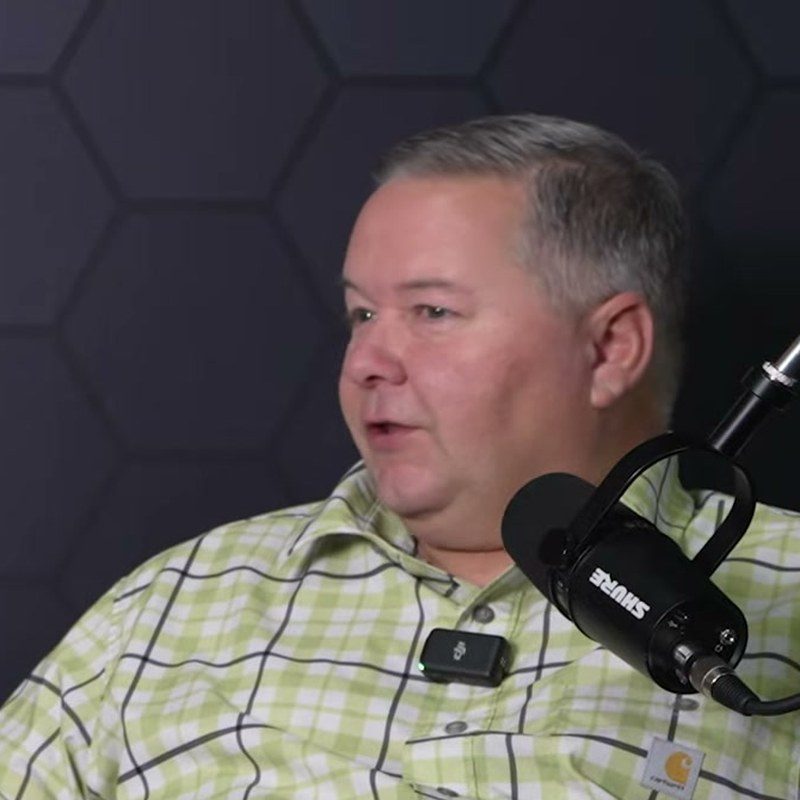 Jos ZamzowFourth generation, Zamzow’s (19:55)
And that person would still miss calls during breaks, at lunch and after hours.
At Moore the problem was the paint desk. Moore sells a lot of paint and is aligned with Benjamin Moore. It ran a time study on phone orders. The finding: “it doesn’t matter if the customer is ordering one gallon or 100 gallons, it’s still about a 12 minute phone call,” said Mark Blickenstaff, Moore’s Divisional Director of Revenue, Growth and Marketing (16:37). Moore moved its paint contractors to ordering by text with a paint salesperson. That turned into a bottleneck too.
What did the two stores build?
Faye, the phone agent. Jos heard a session on AI voice agents at the Do it Best Market in spring 2025. He walked up afterward and asked if he had heard right. Grit Blueprint, the company that produces Grit Guide, built Faye with Zamzow’s. They named her after Jos’s mother. Besides answering, the agent can send the store a short summary of each call. It covers who called, what they wanted and how to reach them.
Ashley, the paint agent. Moore partnered with a company called PaintPal. Contractors text Ashley the way they would text a person. She knows technical specs and which colors can and cannot go on an exterior. She can also cross-reference brands. “She knows the Sherwin equivalent in a Ben Moore color,” Blickenstaff said (17:40). At the end of the conversation, the paint team gets a formatted order and a record of it by email. Then the team mixes the order. Moore promises “a two-hour window from order to job site” (18:22).
“I save 12 minutes of time for a real person. Now, I’m not replacing that real person by any means,” Blickenstaff said (18:30). His reason is sales. After years of taking orders, his people have to sell again, and “taking a paint order doesn’t need to be one of those things that’s just order taking” (20:26).
How do you keep an AI phone agent from recommending the wrong thing?
Limit what it can draw on, then read what it said. Zamzow’s built Faye to answer from information the company picked.
It pulls from information that we wanted to, so it recommends the products that we wanted to recommend.
Jos ZamzowFourth generation, Zamzow’s (22:36)“I didn’t want the chat bot recommending products we didn’t sell or things that we don’t do in our area of the country,” he said (22:36).
Zamzow’s keeps a record of every call: what the caller asked and what Faye told them. The team used those records to correct her answers through the summer. There was a lot to fix at the start, Jos said, and “now it’s just fine tuning” (21:45).
He is plain about the limits. “It’s not perfect,” he said (20:23). But during testing, his team kept laughing out loud at what she could answer, beyond what a new cashier could. His father, who is 78, called Jos after Faye worked out how many cubic feet of potting soil he needed for a planting bed. Few of his people could do that on the phone on the spot, Jos said.
Next on his list: texting a caller the guide they need. One example is the spreader setting guide for when the fertilizer bag got wet. Another is the seed starting guide that says when to plant carrots and onions.
Should the agent say it is AI?
Each store made its own call, and you will have to make yours. Moore’s paint contractors could not tell Ashley was an agent unless Moore told them. Zamzow’s found that many people who still phone a store are not warm to AI. So its latest version opens with “hi, I’m Faye, how can I help you?” instead of announcing a chatbot (23:19).
Before you decide how yours introduces itself, talk to whoever handles your legal questions. Ask whether callers in your state have to be told.

Start with the calls nobody picks up
The agent is only as good as what you feed it. Stefanie Couch said so in the Zamzow’s interview: “I think one of the biggest things that is either a make or break is how good is your knowledge base” (25:23). A knowledge base is the set of written answers and documents the agent draws on. If all it has is your website and your website says little, the agent will say little too.
Start with the simplest version. In her sessions for dealers, she points most stores to an agent. It answers after hours or when nobody picks up. It takes a name, a phone number and what the caller wants. Then it sends that to the counter for a call back. It does not try to sell.
Then treat the call record as a training log. Every answer the agent gets wrong is a question your store needs a written answer for. That answer helps your new hires too. A caller who never gets through has still had an experience with your company.
If we say we’re going to put this effort into training an employee that might leave, if we put the same effort into training our AI agent, we’re going to have a sustainable thing that’s going to get better and better over time.
Jos ZamzowFourth generation, Zamzow’s (25:46)What to do next
- For two weeks of your busy season, keep a tally of calls nobody answered. Use voicemails and call backs to note what the callers wanted.
- Write the answers down: hours, locations, what each store carries, what you do not sell, delivery windows and the 10 questions your counter hears most.
- Start with an agent that takes a name, a number and the request and sends it to the counter. Add product answers later.
- Read every call record each week for the first month. Fix the written answer, not only the one call.
- Decide how the agent introduces itself, and check what your state requires. Then put the same rules on the agent that you would put on a new hire. See the 85/15 rule for checking AI answers. Also see how to give AI your store’s knowledge one job at a time.
The Zamzow’s interview was recorded for an episode sponsored by Do it Best. Grit Blueprint, which produces Grit Guide, built Zamzow’s phone agent.
Questions people ask
Can AI answer the phone for a hardware store?
Yes. Zamzow’s, a 12-store farm, garden and pet chain around Boise, Idaho, uses a phone agent named Faye for calls its staff cannot pick up in busy season. It answers from information the company chose, and Zamzow’s reads the record of each call to fix answers.
How do you train an AI phone agent?
Give it your own answers: what you sell, what you do not sell, hours, locations and the questions customers ask. Then read the call records and correct what it got wrong. Jos Zamzow says the fixes were heavy at the start and are now fine tuning.
Will an AI agent recommend products we don't carry?
Not if you limit it to your own information. Zamzow’s set Faye up so it recommends only the products the company wants recommended and nothing it does not sell or do in its part of the country.
Does an AI agent replace counter staff?
Neither store describes it that way. Moore Lumber’s paint agent saves a person about 12 minutes per order, and Mark Blickenstaff says he is not replacing that person. Zamzow’s uses its agent for calls that were going unanswered while staff helped customers in the store.

Watch the full interviews
Loyal Fans, Lasting Success: Zamzow’s and Mark Blickenstaff of Moore Lumber on AI at an independent lumberyard.
Jos Zamzow is with Zamzows, a 92-year-old chain of 12 stores around Boise, Idaho. He explains how his family starts products in small batches and trains staff to offer help customers will accept. They now answer the phone with an AI agent named Faye.
A Grit Guide original. This piece is built from our own interview.