How to Stop Quoting Blind: Seven Questions to Ask Before You Price a Job
Ask seven questions, read the answers back and send a quote that says what is known and what is open.
You’ll finish with A quote that states its purpose, a list of what is confirmed and what is still open, a name and a date on every open item, and a review time the customer agreed to.
Download the PDFPDF, 667 KB, 9 pagesDownload the slidesPDF, 390 KB, 14 slides
In this guide7 steps
You’ll finish with A quote that states its purpose, a list of what is confirmed and what is still open, a name and a date on every open item, and a review time the customer agreed to.
Ask seven questions, read the answers back and send a quote that says what is known and what is open.
A builder walks up to the counter. “Can you price 18 interior doors?”
You could start typing. You know the door he usually buys. You could hand him a number before his coffee is cold and feel fast.
Here is the trouble. You do not know what the number is for. Grit Guide’s Millwork Sales field guide opens with this same scene. The salesperson asks one thing before she touches the keyboard: is this for a budget, a comparison or an order he is ready to place?
It is a budget. The homeowner has not picked a style yet. That one answer changes the work, because a quote built to order from would rest on choices nobody has made.
This guide is for counter and inside salespeople at dealers and distributors, and for the outside salespeople who bring the requests in. Inside salespeople quote and handle orders from the store or office. It works for doors, windows, trim or any job with choices in it.
Stefanie Couch puts fast quotes first on her list of ways to make a contractor’s job easier. Asking first is how a fast quote also turns out right.
Learn more from Stefanie Couch: Why Contractors Will Control Your Revenue in 2026 (And What to Do About It)
- Everything the customer already sent: plans, lists, texts and emails
- A notes page, or the discovery sheet your company uses
- Your supplier’s current order form for the product, so you know which details it will ask for
- A few minutes with the customer before you build anything
Step 1: Read what they already sent
Go through the plans, the list and the messages first. Mark what is already answered. Circle the gaps. Then ask only about the gaps.
Asking a builder for something he already sent makes extra work for both of you.
Step 2: Ask what the price is for
There are three common answers. Each one asks for a different piece of work from you.
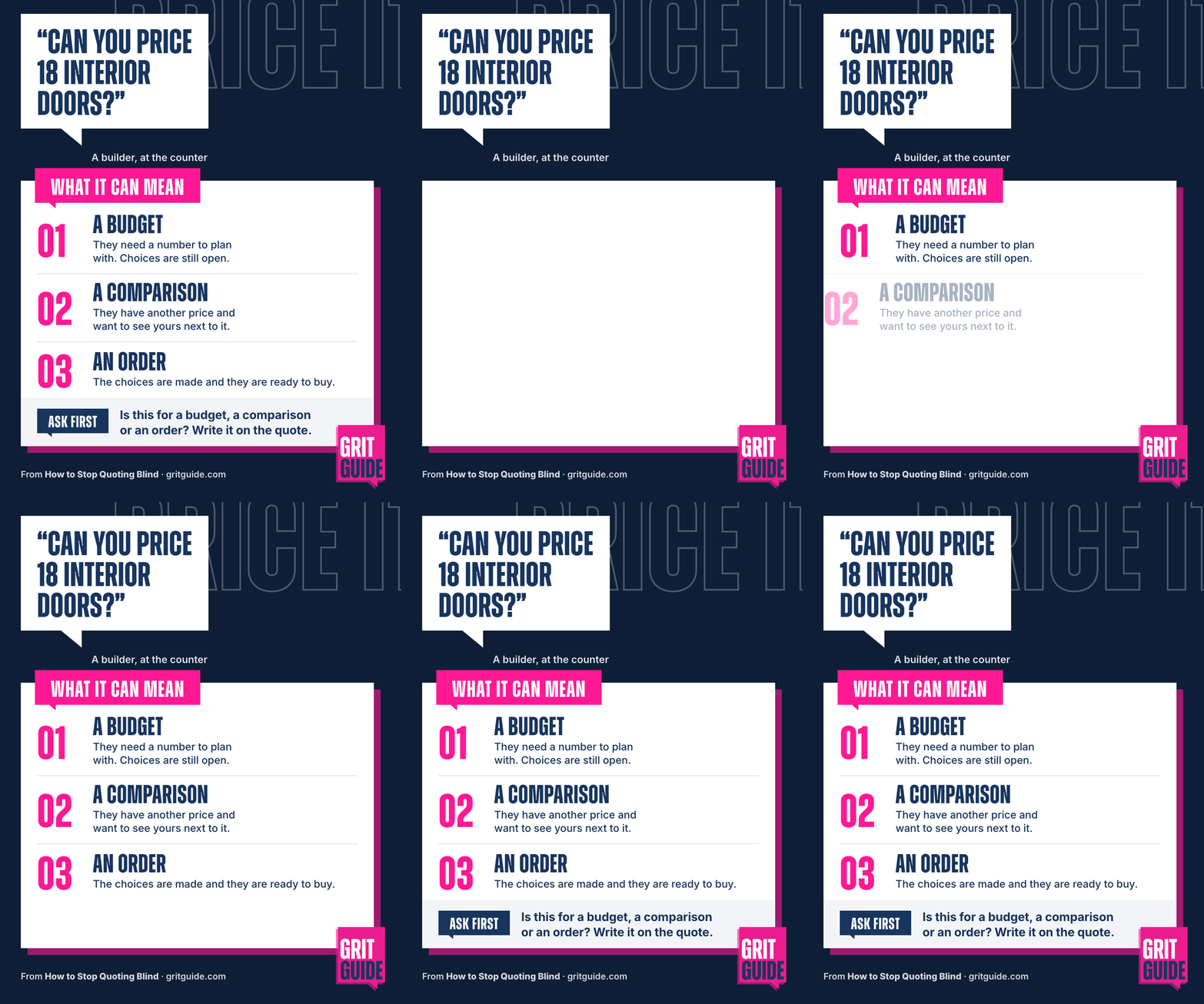
- A budget. They need a number to plan with. Choices are still open.
- A comparison. They have another price and want to see yours next to it.
- An order. The choices are made and they are ready to buy.
Write the answer at the top of your notes. It will go on the quote too.
Step 3: Ask the seven questions
These seven come from the Millwork Sales field guide. Skip any the customer has already answered.
- Project. What is the job, and what stage is it at?
- Selections. What is chosen, and what is still open? Keep “they like it” apart from “they approved it.”
- Priorities. What matters most on this job: style, timing, upkeep or price?
- Budget. What range are we working in? Does it cover products only, or more?
- Timing. When is the product needed on site?
- Approval. Who chooses, who checks the details and who can release the order? To release an order is to tell the supplier to go ahead. These may be three different people.
- Next step. Would a sample, a comparison or a quote help them decide?
Write the answers in the customer’s words.
Step 4: Read the answers back
Say it out loud before you build anything. Use the second script below. If you got something wrong, this is the cheapest moment to find out.
One caution on dates. When a customer says “I need it by the 20th,” you have heard a requested date. It is not a promised date. Lead time is how long an order takes to arrive. Check it with your supplier and your own delivery schedule before you repeat any date back as a promise.
Step 5: Split your notes into known and open
Draw a line down the page. On the left, write what is confirmed. On the right, write what is still open. On a door job the open side often holds the final door schedule, which is the list of every door on the job with its size and details. It may also hold the trim and hardware, the date and who signs off.
Small details like to hide on the open side. On doors, look for the handing, the jamb width and the sill. Handing is the side the hinges are on and the way the door swings. Your supplier’s order form shows how that supplier defines each one, so use its words.
Then give every open item a person and a date. “Schedule TBD” (to be determined) helps no one. “Builder to confirm final door schedule before order release” tells everyone who owes what.
Step 6: Label the quote for what it is
Put the purpose on the quote in plain words: Budget, Comparison or Ready for approval. List what the price assumes. List what it leaves out.
Is a detail the order needs still open? Then keep the quote marked as a budget or a provisional quote under your company’s process. Provisional means not final. Do not hide a guess inside a quote that looks sure of itself. A customer who approves a price has not always approved every product detail.
Step 7: Agree on the review before you send it
A quote is not a plan until both of you know what happens next. Before you hit send, agree on when the two of you will go over it. Also agree on what that review should decide.
Then write down the next action, who owns it and the date. “Interested in doors” does not tell the next person how to help. “Send two options Tuesday. Review Thursday after builder meets homeowner” does.
Finish line
You should now have: A quote that states its purpose, a list of what is confirmed and what is still open, a name and a date on every open item, and a review time the customer agreed to.
Two scripts
Use it when: someone asks for a price and you do not know what they will do with it.
“Happy to price [what they asked for]. So I build the right thing, is this for a budget, a comparison or an order you are ready to place?”
Use it when: you have your answers and are about to build the quote.
“Let me check that I have it right. You need [a budget / a comparison / an order-ready quote] for [scope]. [What is chosen] is set. [What is open] is still open. [Name] will choose, and [name] will confirm the order details. I will send [what you will send] by [day], and we will go over it [day and time].”
Checklist: before you quote
Go down this list before you quote. Any box you can’t tick is the step to go back to.
0 of 9 ticked
You’re done when
- The quote says Budget, Comparison or Ready for approval at the top.
- A teammate could pick up your notes and see what is confirmed, what is open and who owes what.
- Every open item has a name and a date.
- The next action, its owner and its date are written where your team can see them.
What to do next
When a quote turns into an order, switch to the Window and Door Order Checklist. Confirm every line before it goes to the supplier. If the price request came from a builder you have never sat down with, How to Prepare for a First Builder Meeting is the next read.
Take it to your team
The whole guide as a PDF to print or keep, and slides to walk your team through it, one step at a time.
Download the PDFPDF, 667 KB, 9 pagesDownload the slidesPDF, 390 KB, 14 slides
Sources
- Why Contractors Will Control Your Revenue in 2026 (And What to Do About It) Stefanie Couch, Grit Blueprint