How to Prepare for a First Builder Meeting
One hour of prep so your first meeting with a builder ends with a real next step.
For educational purposes only: general information, not legal, tax, financial or safety advice. Check your local codes and talk to a qualified professional before you act. Disclaimer
You’ll finish with A one-page meeting plan: what you know about the builder, who is who on their team, five questions to ask, one useful thing to bring and the next step you will ask for.



Download the PDFPDF, 670 KB, 9 pagesDownload the slidesPDF, 420 KB, 15 slides
In this guide7 steps
You’ll finish with A one-page meeting plan: what you know about the builder, who is who on their team, five questions to ask, one useful thing to bring and the next step you will ask for.
One hour of prep so your first meeting with a builder ends with a real next step.
A builder who agrees to meet you is giving up time. Their jobsite or office never has enough of it. Most first meetings waste that time. The salesperson talks about the company and hands over a line card (a one-page list of the brands and products the company sells). Then the salesperson asks, “So what are you working on?”
You can do better with about an hour of preparation. This guide is for inside salespeople and outside salespeople. Inside salespeople quote and handle orders from the store or office. Outside salespeople visit builders, contractors and jobsites. The guide works at a dealer, a distributor or a manufacturer. It works the same way whether the builder frames forty houses a year or remodels six kitchens. If those company types are new to you, read How the Building Industry Works first.
Will you make the builder’s job easier?
In many sales, the builder or contractor decides what gets installed. They go by what is easiest to install, what they trust, what they have seen work and what they remember. They avoid anything that brings callbacks (return trips to a finished job to fix a problem), delays or headaches.
So the builder across the table has one quiet question. Will this person make my job easier or harder? Your preparation is the first answer they get.
Learn more from Stefanie Couch: Why Contractors Will Control Your Revenue in 2026 (And What to Do About It)
- The builder’s company name, website and any public project photos
- Your own delivery area, lead times (how long an order takes to arrive) and account setup steps, checked this week
- A notebook or notes app you will really use in the meeting
- The name of the person inside your company who would support this account
Step 1: Learn what they build and how they buy
Spend twenty minutes on what is public. Look at their website, their project photos and what they post about. Write down what you can see: the kind of work, the size of the jobs, the areas they work in and any products that show up again and again.
Note whether they build new houses or do repair and remodel work, often shortened to R&R. The two run on different schedules and order in different ways. Do not assume one process fits both.
Then make two short lists: what you know and what you are guessing. Who orders material? Who decides where it comes from? Who do they buy from today? Do not fill in crew size, spending or what they are unhappy about from your own head. The guesses become your questions.
Last, look yourself up. Buyers now research your people as well as your company. If they find nothing, that reads as a risk. Search your own name the way the builder will. If nothing useful comes up, update your LinkedIn profile today. Add a photo and one plain line about what you do.
Step 2: Give the meeting one job
Write one sentence that finishes this line: “When I leave, I want to know…”
For a first meeting, a good answer is about them. For example: “I want to know how they order windows and doors today and what goes wrong.” A meeting with one job is easier to run and easier to end on time.
Michael Tull has sold doors for more than fifty years as a manufacturer’s rep. That is a salesperson who represents manufacturers in a territory. On the Grit Blueprint Podcast he said he asks himself the same things before every call: “What am I gonna talk to them about? What is my goal to leave that place with?”
Step 3: Map who is who
The person you meet may not be the person who orders. The person who orders may not be the one who lives with the problem on site. Before the meeting, sketch the roles and leave the names blank:
- Owner: usually has the final say on suppliers.
- Estimator: works out what a job needs and what it will cost. This person often does the take-off, which means counting and measuring the materials from the plans.
- Project manager: runs the schedule and the budget for a job.
- Superintendent: runs the jobsite day to day and is there when your truck shows up.
- Installer or crew lead: handles your product.
- Office staff: place orders and pay invoices.
At a small remodeler, one person may wear four of these hats. Ask. Your goal is to leave knowing who fills each role you care about.
Step 4: Write five questions about their work
Bring questions a supplier would need answered to serve the account well. Keep them short enough to say out loud.
- What kind of jobs fill most of your year?
- How do you order material for a job today, and who places the order?
- How far ahead do you usually know what you need?
- What does a good delivery look like on your sites?
- When an order goes wrong, what usually caused it?
These cover the work they do, how they buy, their schedule and what they expect from a supplier. If there is time, add one more: “What would make your next job easier?”
Ask, then stay quiet and write down the answer in their words. You will use those words later in your quote (your written price for the job) and your follow-up.
One caution. If a builder tells you they order at the last minute, ask why before you judge it. The reason may be crew timing, a job that ran long or no safe place to store material on site.
Step 5: Bring one useful thing
Do not bring a catalog. Bring one thing that helps with the work you saw in step one. It could be a current lead time on a product they use or a sample they can hold. It could also be a one-page sheet on how your delivery and returns work. The goal is to make their job easier. You also want to give them proof they can show their own customers, such as simple one-pagers and project photos.
Michael Tull has a saying for this: “Show and tell, watch it sell. If you don’t, it won’t.” A product that stays in the car does not get talked about.
If you have a view on something that may be costing them time, say it as an observation. Then ask if it fits. “Builders tell us special-order doors are where schedules slip. Is that true for you?” A special order is a product your company does not stock. Your company has to order it from the manufacturer for one job. Only say a line like that if it is true for you. If they say no, drop it and move on.
Step 6: Know your own answers
A builder will ask what you can do. Before you go, check where you deliver and how often. Check how an account gets opened and who they call with a problem. Also check real lead times for the products they are likely to ask about. When you give a lead time, say what it covers. Ready at the plant and delivered to the site are different dates.
If you do not know something, say so and give a day. Marion Pulse sold windows and doors early in her career. She tells newcomers: “It’s okay to say, I don’t know, and I’ll find the answer for you.” Then find it and call back when you said you would.
Step 7: Ask for a next step and send your notes the same day
Before you leave, ask for one small next step. A set of plans to quote. A visit to a jobsite. An introduction to the person who orders.
Send a short note the same day. Say what you heard, what you will do and by when. Then do it by that day. Michael Tull calls the work after the first yes “keeping it sold.” His rule for it is simple: you do what you say you are going to do.
If your notes are rough, this prompt turns visit notes into a follow-up email. For the calls and texts that come after, use the customer follow-up scripts.
First builder meeting checklist
Tick these off as you go. Any box you can’t tick is the step to go back to.
0 of 9 ticked
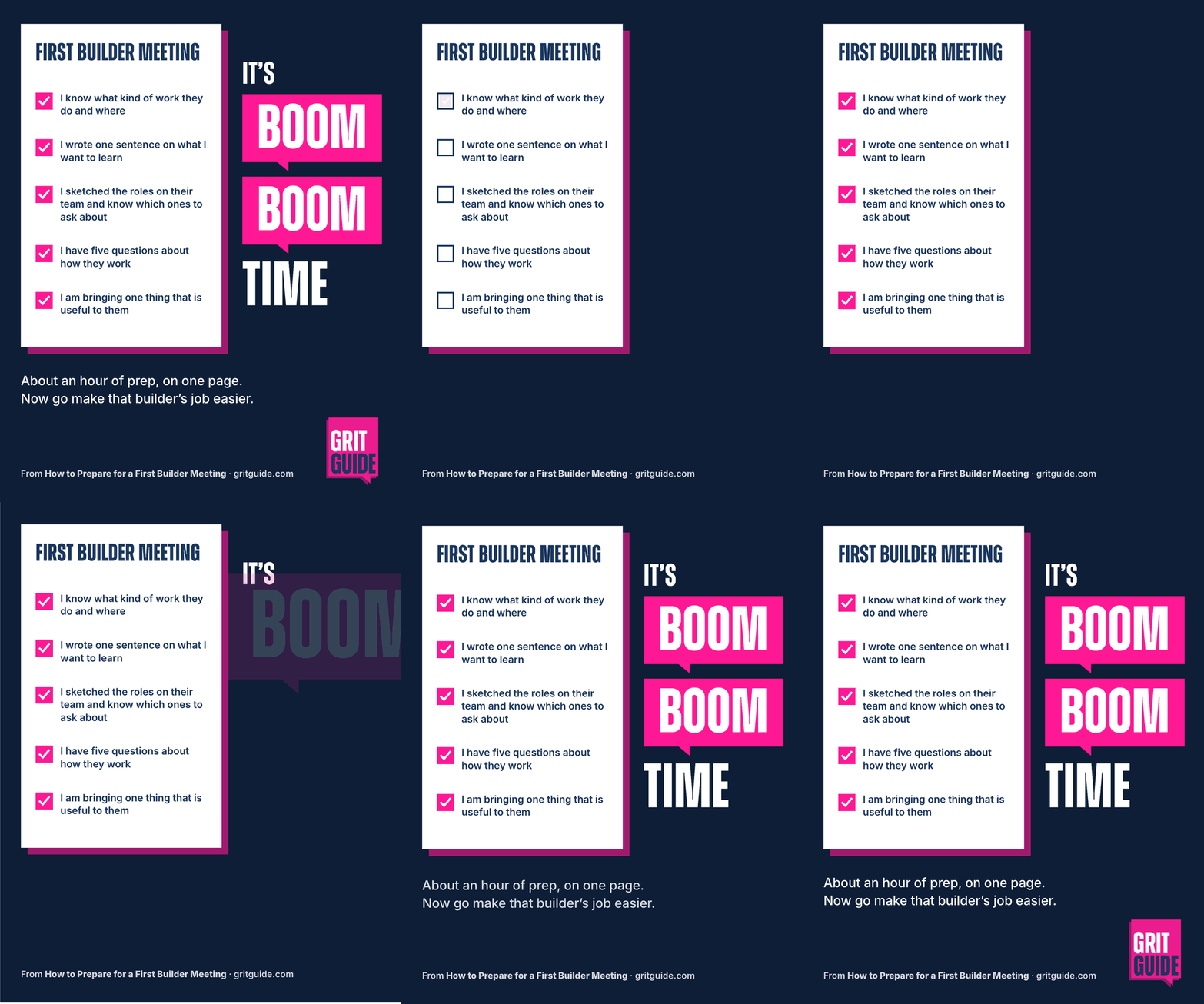
The plan fits on one page on purpose. The first line is what they build and how they buy. If you cannot fill it in, move the meeting back a day and do that part first.
Finish line
You should now have: A one-page meeting plan: what you know about the builder, who is who on their team, five questions to ask, one useful thing to bring and the next step you will ask for.
What to do next
Once the meeting is on the calendar, read The Challenger Sale: The Main Lessons for Building Industry Sellers. It goes deeper on step five: how to bring a customer something useful to think about. If product words came up that you did not know, keep the Building Industry Glossary open.
Disclosure: Marion Pulse is now Client Success Director at Grit Blueprint, which publishes Grit Guide. Her words here come from her 2024 Grit Blueprint Podcast interview, recorded while she was at NFRC.
Episodes in this piece
Take it to your team
The whole guide as a PDF to print or keep, and slides to walk your team through it, one step at a time.
Download the PDFPDF, 670 KB, 9 pagesDownload the slidesPDF, 420 KB, 15 slides
Sources
- Why Contractors Will Control Your Revenue in 2026 (And What to Do About It) Stefanie Couch, Grit Blueprint
- How to Build Trust With Customers in the Building Industry Stefanie Couch, Grit Blueprint
- The Real Reason Customers Buy Again (Grit Blueprint Podcast, Michael Tull with host Stefanie Couch) Grit Guide
- Marion Pulse on Confidence, Patience and Finding Your Place in Fenestration (Grit Blueprint Podcast) (December 2024) Grit Guide